
AI and Software Development Company | Tech Biz Builders

Artificial Intelligence

AI, AI Tools

AI Agent vs AI Automation: Benefits, Use Cases, and Implementation Tips

AI Agent vs AI Automation: Benefits, Use Cases, and Implementation Tips Are you feeling overwhelmed by the buzz around Artificial Intelligence? It’s not just about chatbots anymore. The lines between AI automation and AI agents are becoming increasingly blurred, leading to confusion about which technology is right for your business. Many companies are struggling to understand the nuances and realize the full potential of these tools. This article will break down the key differences between AI agents and AI automation, exploring their respective benefits, practical use cases, and offering actionable tips for successful implementation. We’ll delve into how each approach can streamline operations, boost productivity, and ultimately drive growth. By the end, you’ll have a clear understanding of how to strategically leverage AI to achieve your specific business goals – whether that’s automating repetitive tasks or creating truly intelligent, self-directed systems. | AI Agent vs AI Automation Understanding AI Automation AI automation refers to the use of software and algorithms to perform repetitive, rule-based tasks without human intervention. Think of it as automating existing processes. It’s about taking a well-defined workflow – like data entry, invoice processing, or generating reports – and replacing manual steps with automated solutions. Robotic Process Automation (RPA) is a common form of AI automation, utilizing software robots to mimic human actions within digital systems. Traditionally, automation required significant upfront programming and a rigid, pre-defined structure. However, modern AI-powered automation tools are becoming more adaptable and can handle variations within a process, making them more efficient and less reliant on complex scripting. For example, a marketing team might use AI automation to automatically send personalized email sequences based on customer behavior, or a customer service department could automate the routing of support tickets to the appropriate agent. The key here is consistency and predictability – automating tasks that follow a clear, established pattern. Benefits of AI Automation Implementing AI automation offers a multitude of advantages. Firstly, it dramatically increases efficiency by reducing the time and resources required to complete tasks. Secondly, it minimizes human error, leading to improved data accuracy and reduced operational costs. Thirdly, it frees up human employees to focus on more strategic and creative work, boosting overall productivity. Furthermore, automation provides greater scalability – you can easily handle increased workloads without hiring additional staff. According to a McKinsey report, businesses that successfully implement automation can see productivity gains of up to 30%. Finally, automation improves compliance by ensuring consistent adherence to established procedures. Consider a logistics company automating warehouse inventory management – this reduces stockouts, minimizes waste, and streamlines the entire supply chain. Use Cases for AI Automation The applications of AI automation are incredibly diverse. Here are a few common examples: Finance: Automating invoice processing, reconciliation, and fraud detection. Customer Service: Automating responses to frequently asked questions, routing support tickets, and providing basic troubleshooting. Human Resources: Automating onboarding processes, benefits enrollment, and payroll. Marketing: Automating email marketing campaigns, social media scheduling, and lead generation. Operations: Automating data entry, report generation, and supply chain management. Delving into AI Agents AI agents, on the other hand, represent a more advanced form of AI. They are designed to perceive their environment, make decisions, and take actions to achieve specific goals – often without explicit human instruction. Unlike automation, which follows pre-programmed rules, AI agents learn and adapt over time. They utilize techniques like reinforcement learning and natural language processing to understand complex situations and respond intelligently. Think of them as digital assistants that can proactively solve problems and manage tasks. A key difference is their ability to handle ambiguity and unexpected events. Instead of simply executing a predefined script, an AI agent can analyze the situation, assess the potential consequences, and choose the best course of action. For instance, an AI agent in a smart home could learn your preferences and automatically adjust the temperature, lighting, and entertainment system – all without you having to manually control them. Key Characteristics of AI Agents AI agents possess several defining characteristics: Autonomy: They can operate independently and make decisions without constant human oversight. Learning: They continuously learn from their experiences and improve their performance over time. Adaptability: They can adjust to changing environments and unexpected situations. Goal-Oriented: They are designed to achieve specific objectives. Perception: They can gather information about their surroundings through sensors and data. Examples of AI Agent Applications AI agents are already being used in a growing number of industries. Here are some notable examples: Application Description Benefit Virtual Assistants (Siri, Alexa, Google Assistant) Respond to voice commands, provide information, and control smart home devices. Convenience, accessibility, hands-free operation. Trading Bots Analyze market data and execute trades automatically. Increased speed, reduced emotional bias, 24/7 operation. Autonomous Vehicles Navigate and operate vehicles without human intervention. Improved safety, reduced traffic congestion, increased efficiency. Personalized Healthcare Assistants Monitor patient health, provide medication reminders, and schedule appointments. Improved patient outcomes, reduced healthcare costs, increased patient engagement. Choosing the Right Approach: AI Agent vs. AI Automation So, which is right for you? AI automation is best suited for tasks that are repetitive, rule-based, and well-defined. It’s a solid choice for streamlining existing processes and improving efficiency. AI agents, however, are more appropriate for situations that require adaptability, learning, and decision-making. They excel at handling complex, dynamic environments where pre-programmed rules are insufficient. Often, the most effective strategy involves a combination of both. You might use AI automation to handle routine tasks and AI agents to manage more complex, strategic initiatives. Consider a scenario where an AI agent monitors customer feedback and automatically escalates critical issues to a human agent – this combines the efficiency of automation with the intelligence of an agent. Ultimately, the best approach depends on your specific business needs, goals, and resources. Conclusion Both AI agents and AI automation offer significant opportunities for businesses to improve efficiency, reduce costs, and drive growth. AI automation excels at streamlining repetitive tasks, while AI agents provide the ability to learn, adapt, and make intelligent decisions. Understanding the distinctions

IOT

AI and IoT: Revolutionizing the Future of Connectivity

AI and IoT: Revolutionizing the Future of Connectivity Imagine a world where your appliances anticipate your needs, your vehicles drive themselves, and cities operate with unparalleled efficiency – all powered by the convergence of Artificial Intelligence (AI) and the Internet of Things (IoT). This isn’t science fiction; it’s rapidly becoming reality. The Internet of Things, a network of physical objects embedded with sensors, software, and connectivity, is generating an unprecedented amount of data. However, raw data alone isn’t enough. This is where AI steps in. AI provides the intelligence to analyze this data, extract meaningful insights, and drive action. This comprehensive guide explores how AI is transforming IoT, unlocking new possibilities across industries and shaping the future of connected devices. We’ll delve into the key applications, benefits, challenges, and future trends of this powerful combination. | AI and IoT The Symbiotic Relationship Between AI and IoT IoT devices generate vast amounts of data, but without AI, this data remains largely untapped. AI algorithms, particularly machine learning (ML), excel at processing massive datasets, identifying patterns, and making predictions. This enables a truly intelligent IoT ecosystem where devices can proactively adapt to changing conditions and optimize performance. Consider a smart thermostat: an IoT device that learns your heating/cooling preferences based on your schedule and occupancy, and then uses AI to adjust the temperature for maximum comfort while minimizing energy consumption. This is just one example of how AI and IoT are working together to create smarter, more efficient systems.  Machine Learning in IoT At the heart of many AI-powered IoT applications lies machine learning. Various ML techniques are employed – supervised learning (training models on labeled data), unsupervised learning (discovering patterns in unlabeled data), and reinforcement learning (training agents to make decisions through trial and error). For instance, in predictive maintenance, unsupervised learning algorithms can identify anomalies in sensor data indicating potential equipment failures *before* they occur, allowing for proactive maintenance and preventing costly downtime. This capability alone is reshaping industries from manufacturing to healthcare. Transforming Industries with AI-Powered IoT The integration of AI and IoT isn’t just a technological advancement; it’s a game-changer for numerous industries. The ability to analyze real-time data and automate processes is creating significant efficiencies and unlocking new revenue streams. Let’s explore some key industry applications: Smart Manufacturing In manufacturing, AI-powered IoT enables predictive maintenance, quality control, and optimized production processes. Sensors on machinery continuously monitor performance, and AI algorithms analyze this data to predict potential failures. This allows manufacturers to schedule maintenance during downtime, minimizing disruptions. Furthermore, AI can analyze data from production lines to identify bottlenecks and optimize workflows, leading to increased efficiency and reduced waste. For example, GE uses AI and IoT to monitor jet engine performance, predicting maintenance needs and extending engine life. A summarizes the benefits:Companies like Siemens are leveraging these technologies to improve their manufacturing processes and gain a competitive advantage.HealthcareThe healthcare sector is experiencing a revolution thanks to AI and IoT. Wearable devices track vital signs, and IoT sensors monitor patient conditions remotely. AI algorithms analyze this data to detect early signs of illness, personalize treatment plans, and improve patient outcomes. Remote patient monitoring allows healthcare providers to intervene proactively and prevent hospital readmissions. AI can also assist with diagnosis by analyzing medical images and identifying potential anomalies. Consider how smart pills with embedded sensors can track medication adherence and provide real-time data to patients and doctors.Smart CitiesCities are increasingly adopting AI and IoT to improve the quality of life for their residents. Smart traffic management systems use AI to optimize traffic flow, reduce congestion, and improve air quality. Smart streetlights adjust brightness based on ambient light and occupancy, saving energy. Smart waste management systems use sensors to monitor fill levels and optimize collection routes. AI-powered surveillance systems enhance public safety by detecting suspicious activity and alerting authorities. Barcelona is a prime example of a city successfully implementing these technologies, resulting in lower carbon emissions and enhanced citizen engagement.Overcoming the Challenges of AI & IoT IntegrationWhile the potential benefits of combining AI and IoT are immense, significant challenges need to be addressed to ensure successful implementation. These include data security and privacy concerns, scalability issues, and the need for skilled professionals to develop and manage these systems. Data breaches are a major concern, particularly with the increasing number of connected devices. Robust security measures, including encryption and access controls, are essential to protect sensitive data. Furthermore, the sheer volume of data generated by IoT devices requires scalable infrastructure and efficient data management strategies. Finally, a shortage of skilled AI and IoT professionals poses a significant hurdle to adoption. Investing in training and education is crucial to bridge this skills gap.Data Security and PrivacyIoT devices often collect and transmit sensitive personal information, making them attractive targets for cyberattacks. Data breaches can have serious consequences, including identity theft and financial loss. Strong encryption, secure authentication protocols, and regular security audits are essential to protect data. Compliance with data privacy regulations, such as GDPR and CCPA, is also crucial. Implementing anonymization and data aggregation techniques can further mitigate privacy risks. It’s vital for organizations to adopt a “security-by-design” approach, incorporating security considerations into every stage of the development lifecycle.The Future of AI and IoT: Key TrendsThe convergence of AI and IoT is still in its early stages, and the future holds exciting possibilities. Here are some key trends shaping the evolution of this technology: Edge Computing: Processing data closer to the source, reducing latency and bandwidth requirements. This is particularly important for applications requiring real-time response. 5G Connectivity: Providing faster and more reliable wireless communication for IoT devices, enabling new applications such as autonomous vehicles and augmented reality. Digital Twins: Creating virtual replicas of physical assets, allowing for real-time monitoring, simulation, and optimization. Federated Learning: Training AI models on decentralized data sources without sharing the raw data, improving privacy and security. AI-Powered Device Management: Automating the provisioning, monitoring, and updating of IoT devices. These trends are expected to accelerate the adoption of

AI

Understanding Generative AI: From ChatGPT to DALL-E

Understanding Generative AI: From ChatGPT to DALL-E The rise of artificial intelligence (AI) has been one of the most transformative trends in recent years. Among these innovations, generative AI stands out as a powerful tool capable of creating new data, content, and experiences. This blog article delves into the fascinating world of generative AI, exploring how it works, its applications, and two prominent examples: ChatGPT and DALL-E. What is Generative AI? Generative AI refers to a type of machine learning that enables computers to create new data or content that resembles existing data. This can include text, images, music, videos, and more. Unlike descriptive AI, which analyzes and interprets existing data, generative AI creates original content based on the patterns it learns from training data. How Does Generative AI Work? The process of creating new data involves several steps: Data Collection: The system is trained on a large dataset containing examples of the type of content it needs to generate. Pattern Recognition: The AI learns to recognize patterns and structures within the data. Creation: Using the learned patterns, the system generates new data that is similar to the training examples. The Power of ChatGPT ChatGPT, developed by OpenAI, is a prime example of generative AI in action. It’s an advanced language model that can understand and generate human-like text on a wide range of topics. Here’s how it works: Input Prompt: You provide a prompt or question. Analysis: ChatGPT processes the input, analyzing the context and relevant information. Response Generation: It generates a response that is coherent, informative, and often creative. Applications of ChatGPT ChatGPT has numerous applications across various industries: Customer Support: Automating customer service to provide immediate assistance. Education: Creating personalized learning experiences and assisting in homework. Creative Writing: Generating story ideas, poems, and other forms of creative content. The Magic of DALL-E DALL-E, created by OpenAI, is another groundbreaking example of generative AI. It’s a tool that can generate images based on text descriptions. Here’s how it works: Input Prompt: You provide a text description of what you want to create. Analysis and Synthesis: DALL-E interprets the description and synthesizes visual elements based on its training data. Image Generation: It outputs an image that closely matches the described scenario. Applications of DALL-E DALL-E opens up new possibilities in fields such as art, design, and content creation: Creative Design: Generating custom graphics for marketing campaigns, logos, and more. Illustration and Animation: Creating unique illustrations and animations quickly. Concept Development: Brainstorming ideas for new products or services. Conclusion Generative AI, with its ability to create new data and content from existing patterns, is revolutionizing the way we interact with technology. Tools like ChatGPT and DALL-E demonstrate how generative AI can enhance efficiency, creativity, and innovation across various industries. As this field continues to evolve, it’s exciting to think about the possibilities that lie ahead. By understanding generative AI, you’re gaining insight into a powerful tool that can transform the way we live, work, and create. So, whether you’re interested in customer support, creative writing, or visual design, keep an eye on this dynamic area of technology as it continues to grow and shape our digital landscape. Image by: Sanket Mishra

AI Agent

AI Agent vs AI Automation: Choosing the Right Strategy for Digital Marketing

AI Agent vs AI Automation: Choosing the Right Strategy for Digital Marketing Are you feeling overwhelmed by the sheer volume of digital marketing tasks? Do you spend countless hours scheduling social media posts, crafting email campaigns, and analyzing data – only to feel like you’re still falling behind? The rise of artificial intelligence (AI) promises a solution, but navigating the landscape of AI tools can be confusing. Many marketers are unsure whether to invest in AI automation – which handles repetitive tasks – or AI agents – which actively learn and adapt. This blog post will break down the differences between these two approaches, helping you determine which strategy is best suited for your digital marketing goals and budget. We’ll explore the strengths and weaknesses of each, providing practical examples and actionable tips to help you leverage AI effectively. Ultimately, understanding the nuances between AI agents and AI automation will empower you to streamline your workflows, boost your ROI, and focus on the strategic aspects of your marketing efforts. | AI Agent vs AI Automation Understanding AI Automation in Digital Marketing AI automation focuses on streamlining repetitive, rule-based tasks. Think of it as a sophisticated robot that executes pre-defined instructions. It’s incredibly effective for tasks that require consistency and don’t demand creative input. Traditionally, this has included things like social media scheduling, email marketing automation (sending out drip campaigns based on triggers), and basic data reporting. However, modern AI automation tools are becoming increasingly sophisticated, utilizing machine learning to optimize these processes. For instance, tools like HubSpot’s Marketing Hub leverage AI to predict the best time to send emails, personalize content based on user behavior, and automatically segment audiences. A recent study by Gartner predicts that AI-powered automation will save businesses over $100 billion annually by 2027, highlighting its growing importance. The key benefit of automation is efficiency – it frees up marketers to concentrate on higher-level activities like strategy, content creation, and campaign optimization. It’s about doing things *for* you, consistently and accurately. Examples of AI Automation Tools Social Media Scheduling: Buffer, Hootsuite Email Marketing Automation: Mailchimp, ActiveCampaign Lead Scoring: Salesforce Einstein, Marketo Chatbots: ManyChat, Drift While automation excels at consistency, it’s limited by its programming. It can’t handle unexpected situations or adapt to changing customer preferences without manual adjustments. It’s a powerful tool, but it’s not a replacement for human judgment. Furthermore, setting up and configuring automation workflows can require technical expertise, although many platforms are becoming increasingly user-friendly. Delving into AI Agents: Intelligent Assistants for Marketing AI agents, on the other hand, represent a more advanced form of AI. They’re designed to learn, adapt, and make decisions – much like a human marketing assistant. Instead of simply following instructions, AI agents analyze data, identify patterns, and proactively suggest actions. They can, for example, monitor social media conversations to identify trending topics and sentiment, automatically adjust ad bids based on performance, or even generate creative content variations. Tools like Jasper.ai and Copy.ai are prime examples of AI agents focused on content creation, while others, like Persado, specialize in optimizing marketing copy for maximum impact. A case study by McKinsey found that companies using AI agents for customer service saw a 30% reduction in support costs and a 20% increase in customer satisfaction. The power of AI agents lies in their ability to augment human capabilities, not replace them. How AI Agents Differ from Traditional Automation Feature AI Automation AI Agent Decision Making Rule-based, pre-defined Adaptive, learns from data Creativity Limited Capable of generating new ideas Adaptability Low – requires manual adjustments High – adjusts to changing conditions Human Interaction Minimal Can engage in more complex conversations AI agents require more initial setup and training, but they offer a significantly higher level of flexibility and intelligence. They’re particularly valuable for tasks that require a nuanced understanding of customer behavior and market trends. However, it’s crucial to remember that AI agents are still under development, and their outputs may require human oversight and refinement. They’re best used in conjunction with automation, creating a synergistic approach to marketing. Combining AI Automation and AI Agents for Optimal Results The most effective digital marketing strategies often involve a combination of both AI automation and AI agents. Start by identifying your most repetitive tasks – these are ideal candidates for automation. Then, explore AI agent tools that can handle more complex, strategic activities. For example, you could automate your social media scheduling using a tool like Buffer, while simultaneously using an AI agent like Jasper.ai to generate engaging content for your posts. This allows you to free up your time and resources, while still leveraging the power of AI to improve your marketing performance. Consider a phased approach – start with a small pilot project to test the waters and gradually expand your use of AI as you gain confidence. Don’t try to implement everything at once; focus on delivering tangible results and building a solid foundation for future growth. A Strategic Workflow Example Automation: Schedule social media posts using Buffer. AI Agent: Generate multiple variations of social media captions using Jasper.ai. Human Review: Select the best caption and schedule it. AI Agent: Monitor social media conversations and identify relevant keywords. Automation: Trigger email marketing campaigns based on identified keywords. Ultimately, the choice between AI automation and AI agents depends on your specific needs, budget, and technical capabilities. By understanding the strengths and weaknesses of each approach, you can create a digital marketing strategy that is both efficient and effective. The future of marketing is undoubtedly intertwined with AI, and embracing these technologies – strategically – is essential for staying ahead of the curve. Conclusion In conclusion, both AI automation and AI agents offer significant benefits for digital marketers, but they serve different purposes. AI automation excels at streamlining repetitive tasks, increasing efficiency, and freeing up valuable time. AI agents, on the other hand, provide a more intelligent and adaptive approach, capable of learning, making decisions, and generating creative content. The most successful

AI, AI Automation

From AI Agents to AI Automation: A Complete Guide to Smarter Workflows

From AI Agents to AI Automation: A Complete Guide to Smarter Workflows Are you feeling overwhelmed by your daily tasks? Do you spend countless hours on repetitive processes, leaving you little time for strategic thinking and creative work? The rise of artificial intelligence (AI) is no longer a futuristic concept – it’s a present-day reality transforming how we work. Many businesses are struggling to understand the difference between AI agents and AI automation, and how to effectively leverage these technologies to boost productivity and efficiency. This guide will break down the nuances of both, providing a clear roadmap to implementing smarter workflows and unlocking the true potential of AI. You’ll learn how to identify opportunities for automation, understand the capabilities of AI agents, and ultimately, build a more streamlined and productive work environment. We’ll cover practical strategies, real-world examples, and actionable tips to help you navigate this exciting new landscape – regardless of your technical expertise. | AI Agents and AI Automation Understanding AI Agents: Your Intelligent Assistants AI agents represent a significant shift in how we interact with technology. Unlike traditional automation, which follows pre-programmed rules, AI agents possess a degree of autonomy and can learn and adapt to changing circumstances. They’re essentially digital assistants that can perform tasks, answer questions, and even make decisions – all without constant human intervention. Think of them as specialized software programs that mimic human intelligence, capable of understanding natural language and responding in a contextually relevant manner. These agents aren’t just about executing commands; they’re about understanding *why* a command is given and responding accordingly. This is achieved through techniques like Natural Language Processing (NLP) and Machine Learning (ML). Key Capabilities of AI Agents Natural Language Understanding (NLU): Agents can interpret and understand human language, even with variations in phrasing or tone. Task Execution: They can perform a wide range of tasks, from scheduling meetings to generating reports. Learning and Adaptation: Through ML, agents continuously improve their performance based on user interactions and data analysis. Personalization: Agents can tailor their responses and recommendations to individual user preferences. A compelling example of an AI agent in action is a customer service chatbot. Instead of simply providing pre-written answers, a sophisticated chatbot can understand the customer’s issue, access relevant information, and offer personalized solutions. According to a recent report by Gartner, AI agents are projected to handle 85% of customer interactions by 2025. This demonstrates the growing demand and potential of this technology. Furthermore, AI agents are increasingly being used in internal operations, assisting employees with research, data analysis, and even drafting emails – freeing up valuable time for more strategic work. Delving into AI Automation: Streamlining Processes AI automation goes beyond simple task execution; it focuses on automating entire workflows and processes. This involves using AI technologies – such as Robotic Process Automation (RPA) combined with AI – to mimic human actions within software applications. RPA bots, often referred to as “digital workers,” can be programmed to perform repetitive, rule-based tasks, like data entry, invoice processing, and report generation. However, the true power of AI automation lies in its ability to *learn* and adapt these rules, moving beyond rigid scripting to handle more complex and dynamic scenarios. This is where the integration of AI, particularly machine learning, becomes crucial. Types of AI Automation RPA (Robotic Process Automation): Automates repetitive, rule-based tasks. Intelligent Document Processing (IDP): Uses AI to extract data from unstructured documents like invoices and contracts. Process Mining: Analyzes existing workflows to identify automation opportunities. Cognitive Automation: Combines RPA with AI to automate more complex, decision-making processes. Consider a logistics company. Traditionally, tracking shipments involved manual data entry and phone calls. Now, an AI-powered automation system can automatically scan shipping labels, update tracking information in real-time, and proactively notify customers of any delays – all without human intervention. This not only reduces errors and improves efficiency but also significantly lowers operational costs. A case study by McKinsey found that companies implementing AI automation can see a 20-30% increase in productivity and a 15-25% reduction in operational costs. The key is to start with well-defined, repetitive processes and gradually expand automation efforts as the technology matures. Bridging the Gap: AI Agents vs. AI Automation It’s important to distinguish between AI agents and AI automation, as they serve different purposes. AI agents are designed to *assist* humans, while AI automation is designed to *replace* human tasks. Think of an AI agent as a helpful colleague, and AI automation as a tireless worker. While they can often work together – for example, an AI agent might trigger an automation workflow – they are fundamentally different concepts. The most effective strategies often involve a hybrid approach, leveraging the strengths of both to create truly intelligent workflows. Feature AI Agents AI Automation Focus Human Assistance Task Replacement Autonomy Moderate – Learns and Adapts High – Executes Pre-defined Rules Interaction Style Natural Language Rule-Based Typical Use Cases Customer Service, Research, Content Generation Data Entry, Invoice Processing, Report Generation For instance, a marketing team could use an AI agent to generate initial drafts of social media posts, and then use AI automation to schedule and publish those posts across various platforms. This combination of agent and automation allows for both creativity and efficiency. Ultimately, the best approach depends on the specific needs and goals of the organization. Investing in a pilot project to test both AI agents and AI automation is a crucial step in determining the optimal strategy. Conclusion: Embracing the Future of Work The convergence of AI agents and AI automation is fundamentally reshaping the way we work, offering unprecedented opportunities for increased productivity, reduced costs, and improved employee satisfaction. AI agents provide intelligent assistance, while AI automation streamlines processes, creating a powerful synergy that can transform entire organizations. As AI technology continues to evolve, it’s crucial for businesses to embrace these advancements and strategically integrate them into their workflows. Don’t view AI as a threat, but rather as a tool to augment human capabilities and

IOT

Smart Cities Powered by AI and IoT: Building Tomorrow’s Infrastructure

Smart Cities Powered by AI and IoT: Building Tomorrow’s Infrastructure Imagine a city that anticipates your needs, optimizes traffic flow, and enhances public safety – all powered by intelligent technology. This isn’t science fiction; it’s the reality of smart cities, rapidly emerging as a crucial component of sustainable urban development. However, many cities struggle with outdated infrastructure, rising costs, and increasing demands on resources. Smart city initiatives, fueled by the convergence of Artificial Intelligence (AI) and the Internet of Things (IoT), offer a transformative solution. This article will explore how these technologies are reshaping urban environments, boosting efficiency, and creating a more livable future. We’ll delve into the core components of a smart city, real-world examples, and the challenges and opportunities that lie ahead. Get ready to discover how AI and IoT are building tomorrow’s infrastructure – one smart city at a time. | Smart Cities AI IoT The Convergence of AI and IoT: A Foundation for Smart Cities The heart of a smart city lies in the seamless integration of AI and IoT. IoT devices—sensors, cameras, and other hardware—collect data from various aspects of city life, from traffic patterns to air quality. This vast amount of data, however, is only valuable when analyzed and acted upon. This is where AI steps in. AI algorithms process the data, identify trends, predict outcomes, and automate responses. AI can analyze traffic patterns in real-time to optimize traffic light timing, predict energy consumption, and detect anomalies in infrastructure. Without the data generated by IoT devices and the analytical power of AI, smart city initiatives would remain largely theoretical. This combination creates a powerful synergy, transforming raw data into actionable insights and driving real-world improvements. The Role of IoT in Data Collection IoT devices are the eyes and ears of a smart city. They gather information on a massive scale, contributing to a comprehensive understanding of urban environments. Here are some key examples of IoT applications: Smart Sensors: Monitor traffic flow, air quality, noise levels, and structural integrity of buildings. Smart Lighting: Adjust brightness based on occupancy and ambient light levels, saving energy. Smart Waste Management: Detect fill levels in trash bins and optimize collection routes. Connected Vehicles: Share real-time traffic information and improve navigation. These devices are often connected via wireless networks – Wi-Fi, cellular, or LoRaWAN – enabling them to communicate with each other and with central systems. The data collected is then transmitted to cloud platforms for processing and analysis. This reliance on interconnected devices and data streams is fundamental to the success of any smart city strategy. AI-Powered Optimization: Enhancing Efficiency and Services AI isn’t just about collecting data; it’s about using that data to optimize city operations. AI algorithms can analyze complex datasets to identify patterns, predict future events, and automate decision-making, leading to significant improvements in efficiency and service delivery. For example, AI-powered traffic management systems can dynamically adjust traffic light timings based on real-time traffic conditions, reducing congestion and commute times. Predictive maintenance algorithms can analyze sensor data from infrastructure to identify potential failures before they occur, minimizing downtime and reducing repair costs. Furthermore, AI can personalize services for citizens, providing tailored recommendations and support. Predictive Maintenance: Reducing Infrastructure Costs Infrastructure maintenance is a significant expense for cities worldwide. AI-powered predictive maintenance can drastically reduce these costs by proactively identifying potential problems. Here’s how it works: Component Sensor Data AI Application Benefit Water Pipes Pressure, Flow Rate, Vibration Anomaly Detection, Predictive Modeling Reduced leaks, lower repair costs Roads Strain, Temperature, Vibration Condition Monitoring, Predictive Cracking Extending road lifespan, preventing costly repairs Bridges Strain, Deflection, Corrosion Structural Health Monitoring, Risk Assessment Enhanced safety, preventing catastrophic failures By analyzing historical data and real-time sensor readings, AI models can predict when maintenance is required, allowing for proactive repairs rather than reactive fixes. This reduces downtime, prevents costly failures, and extends the lifespan of critical infrastructure. Cities like Singapore and Amsterdam are actively deploying predictive maintenance solutions to enhance the reliability and sustainability of their infrastructure. Smart Mobility: Revolutionizing Transportation Transportation is a key area where smart city technologies are making a significant impact. IoT sensors and AI algorithms are transforming how people move around cities, making transportation more efficient, sustainable, and convenient. Smart traffic management systems, connected and autonomous vehicles, and optimized public transportation are all driving this revolution. Connected vehicles can communicate with each other and with infrastructure, sharing real-time traffic information and reducing the need for individual navigation. Autonomous vehicles promise to further optimize traffic flow, reduce accidents, and improve accessibility for people with disabilities. Furthermore, data-driven insights from smart parking systems help drivers find available parking spaces more easily, reducing congestion and emissions. Connected and Autonomous Vehicles: The Future of Mobility The development of connected and autonomous vehicles (CAVs) is a major focus of smart city initiatives. These vehicles utilize a network of sensors, cameras, and AI algorithms to perceive their surroundings and navigate safely. The benefits of CAVs are numerous: Reduced Accidents: CAVs can react faster and more consistently than human drivers, potentially reducing accidents. Improved Traffic Flow: CAVs can communicate with each other to coordinate their movements, reducing congestion. Increased Accessibility: CAVs can provide mobility for people who cannot drive themselves. Reduced Emissions: CAVs can optimize fuel efficiency and reduce emissions. However, the widespread adoption of CAVs faces challenges, including regulatory hurdles, cybersecurity concerns, and public acceptance. Nevertheless, the potential benefits are enormous, promising to reshape urban mobility and improve quality of life. Challenges and Opportunities: Navigating the Smart City Landscape While the potential benefits of smart cities are undeniable, there are also significant challenges to overcome. Data privacy and security are paramount concerns. As cities collect vast amounts of data from citizens and devices, protecting this data from unauthorized access and misuse is crucial. Addressing the digital divide is also essential. Not all citizens have equal access to technology, and smart city initiatives must ensure that all residents can benefit from the advancements. Cost and implementation complexities represent another hurdle. Deploying and maintaining

Business Technology

The Rise of AI in Business: Transforming Operations and Customer Experience

Artificial intelligence has evolved from a futuristic concept to a fundamental business tool that’s revolutionizing how companies operate and serve their customers. From streamlining internal processes to delivering personalized customer experiences, AI is reshaping the business landscape across every industry. Organizations that embrace these technologies are discovering unprecedented opportunities for growth, efficiency, and competitive advantage. | AI in Business How AI is Transforming Business Operations Automation of Routine Tasks One of the most immediate impacts of AI in business has been the automation of repetitive, time-consuming tasks. Machine learning algorithms now handle everything from data entry and invoice processing to inventory management and employee scheduling. This shift allows human workers to focus on strategic thinking, creative problem-solving, and relationship building—activities that require uniquely human skills. Companies implementing AI-powered automation report productivity increases of 20-40% in affected departments, with some organizations saving thousands of employee hours annually. Predictive Analytics and Data-Driven Decision Making AI’s ability to process and analyze massive datasets has transformed how businesses make strategic decisions. Predictive analytics tools can identify patterns invisible to human analysts, forecasting market trends, customer behavior, and potential operational bottlenecks before they occur. Retailers use AI to optimize inventory levels and predict seasonal demand fluctuations, while manufacturers leverage predictive maintenance algorithms to prevent equipment failures and minimize costly downtime. This data-driven approach reduces guesswork and enables more confident, informed business strategies. Supply Chain Optimization Supply chain management has become significantly more sophisticated with AI integration. Advanced algorithms track shipments in real-time, optimize delivery routes based on traffic and weather conditions, and automatically adjust procurement schedules based on demand forecasts. During supply chain disruptions, AI systems can quickly identify alternative suppliers or reroute shipments, minimizing delays and maintaining business continuity. Companies using AI-powered supply chain solutions have reported cost reductions of 15-25% while improving delivery times and accuracy. Revolutionizing Customer Experience with AI Personalization at Scale AI enables businesses to deliver personalized experiences to millions of customers simultaneously. E-commerce platforms use recommendation engines that analyze browsing history, purchase patterns, and similar customer profiles to suggest products with remarkable accuracy. Streaming services curate content based on viewing habits, while news platforms customize article feeds to match reader interests. This level of personalization, which would be impossible to achieve manually, increases customer engagement, satisfaction, and loyalty while driving revenue growth. 24/7 Customer Support Through Chatbots and Virtual Assistants AI-powered chatbots and virtual assistants have transformed customer service by providing instant, round-the-clock support. These intelligent systems handle common inquiries, process returns, track orders, and troubleshoot basic technical issues without human intervention. Modern chatbots use natural language processing to understand context and sentiment, delivering increasingly natural conversational experiences. When issues require human expertise, AI systems seamlessly transfer customers to appropriate representatives along with conversation history and context, ensuring smooth handoffs and faster resolution times. Voice and Sentiment Analysis Advanced AI tools now analyze customer interactions across phone calls, emails, and social media to gauge sentiment and identify emerging issues. This capability allows businesses to proactively address customer concerns before they escalate, spot training opportunities for support staff, and identify products or services that consistently generate complaints. Voice analytics can detect frustration or confusion in real-time during calls, prompting systems to offer assistance to customer service representatives or escalate issues to supervisors. Industry-Specific AI Applications Healthcare: Diagnosis and Treatment Healthcare organizations are using AI to analyze medical images, predict patient outcomes, and personalize treatment plans. Machine learning algorithms can detect anomalies in X-rays and MRIs with accuracy matching or exceeding human radiologists, while predictive models help identify patients at risk for specific conditions. Administrative AI applications are streamlining appointment scheduling, billing, and insurance claims processing, reducing overhead costs and allowing medical professionals to spend more time with patients. Financial Services: Fraud Detection and Risk Assessment Banks and financial institutions leverage AI to protect customers and manage risk. Machine learning models analyze transaction patterns to identify potentially fraudulent activity in milliseconds, blocking suspicious charges before damage occurs. Credit scoring algorithms evaluate borrower risk using thousands of data points, while AI-powered investment platforms provide personalized portfolio recommendations and automated trading strategies. These applications have significantly reduced fraud losses while expanding access to financial services. Retail: Inventory Management and Customer Insights Retailers use AI to optimize everything from store layouts to pricing strategies. Computer vision systems monitor shelf stock levels and alert staff when popular items need replenishment. Dynamic pricing algorithms adjust costs based on demand, competitor pricing, and inventory levels to maximize revenue. Customer behavior analysis reveals shopping patterns, helping retailers plan promotions, optimize product placement, and forecast trends with greater accuracy. Manufacturing: Quality Control and Predictive Maintenance Manufacturing facilities deploy AI-powered vision systems that inspect products with precision impossible for human quality control workers, identifying defects at microscopic levels. Predictive maintenance algorithms monitor equipment performance, detecting subtle changes that indicate impending failures and scheduling repairs during planned downtime. This proactive approach minimizes unexpected breakdowns, extends equipment lifespan, and reduces maintenance costs while ensuring consistent product quality. Overcoming Challenges in AI Implementation Data Quality and Integration Successful AI implementation requires high-quality, well-organized data. Many businesses struggle with siloed information across different systems and departments, inconsistent data formats, and incomplete records. Organizations must invest in data infrastructure, establish governance policies, and implement integration solutions before AI systems can deliver meaningful results. This foundational work, while time-consuming, is essential for sustainable AI success. Employee Training and Change Management Introducing AI technologies often requires significant cultural shifts within organizations. Employees may fear job displacement or feel uncomfortable working alongside AI systems. Successful implementations include comprehensive training programs that help staff understand how AI enhances rather than replaces their roles. Clear communication about AI’s purpose, transparent implementation processes, and opportunities for employees to provide feedback all contribute to smoother adoption and better outcomes. Ethical Considerations and Bias Mitigation AI systems can perpetuate or amplify biases present in training data, leading to unfair outcomes in hiring, lending, and customer service. Responsible businesses regularly audit their AI systems for bias, ensure diverse teams participate in AI development,

AgentExecutor
AI Automation

Understanding AgentExecutor: Building Intelligent AI Agents with LangChain

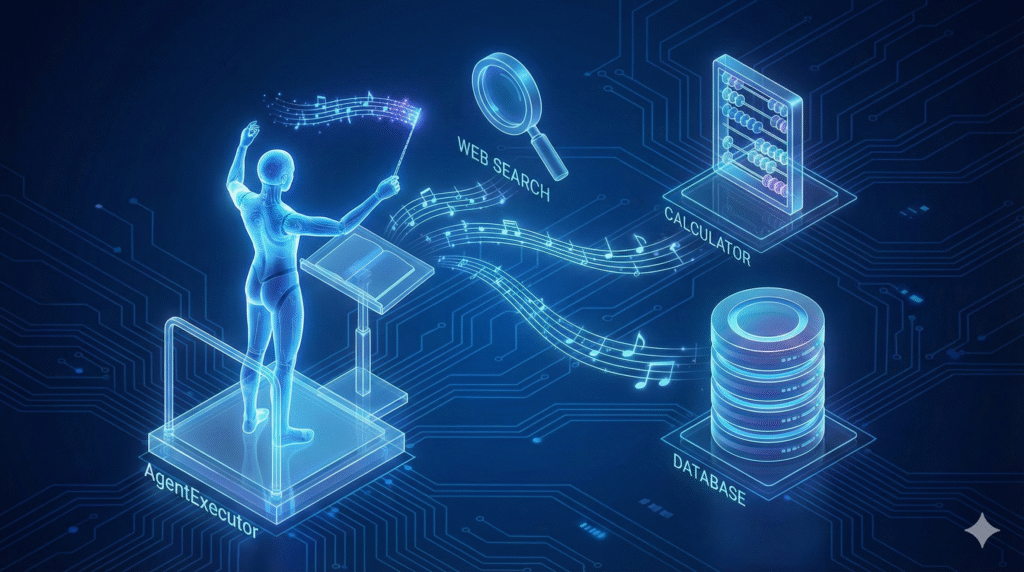
In the rapidly evolving world of artificial intelligence, building agents that can reason, make decisions, and use tools has become essential. At the heart of this capability lies a powerful component called AgentExecutor. Whether you’re developing chatbots, automation systems, or complex AI workflows, understanding AgentExecutor is crucial for creating intelligent, tool-using AI applications. What is AgentExecutor? AgentExecutor is a smart controller in LangChain that runs agent-based workflows powered by large language models and external tools. Rather than simply generating text responses, AgentExecutor enables your AI to think strategically, use tools dynamically, and solve complex multi-step problems. Think of AgentExecutor as a conductor orchestrating an AI symphony. It manages the entire lifecycle of an agent’s decision-making process, from receiving a query to delivering a final answer while intelligently calling various tools along the way. Why Do You Need AgentExecutor? Traditional language models are limited to generating text based on their training data. But what happens when you need your AI to: AgentExecutor allows your AI to behave like a reasoning assistant that can use tools to solve complex, multi-step queries. It bridges the gap between simple text generation and true AI agents that can interact with the world. How AgentExecutor Works: The Core Mechanism The AgentExecutor orchestrates the execution of agents by calling them, executing returned actions, and then calling them again with the result of executed actions. This iterative process continues until a final answer is reached. The execution loop follows this pattern: This cycle repeats until the agent either finds a satisfactory answer or reaches a maximum iteration limit. Key Components of AgentExecutor 1. The Agent The agent is the brain of the operation, powered by a large language model. It analyzes the task, reasons about the best approach, and decides which tools to invoke. 2. Tools Tools are functions or capabilities that the agent can use. Examples include: 3. Memory (Optional) Memory allows the agent to maintain context across interactions, enabling conversational experiences. 4. Iteration Control AgentExecutor includes safeguards like maximum iterations to prevent infinite loops and control execution costs. Building Your First AgentExecutor: A Practical Example Here’s how to create a basic AgentExecutor in LangChain: Common Use Cases for AgentExecutor 1. Research Assistants Build agents that can search multiple sources, synthesize information, and provide comprehensive answers with citations. 2. Data Analysis Agents Create agents that can query databases, perform calculations, and generate insights from complex datasets. 3. Customer Support Automation Deploy agents that can look up customer information, search knowledge bases, and resolve issues autonomously. 4. Workflow Automation Develop agents that orchestrate multi-step business processes, making decisions and calling appropriate services along the way. Advanced AgentExecutor Features Streaming Responses AgentExecutor adapts its behavior based on workflow execution mode, emitting incremental events as the agent produces tokens during streaming. Error Handling AgentExecutor provides robust error handling mechanisms to gracefully manage tool failures and parsing errors. Custom Agent Types Beyond the standard ReAct (Reasoning + Action) pattern, you can implement custom agent logic to suit specific requirements. State Management For complex applications, AgentExecutor can maintain and update state throughout the execution process. Best Practices for Using AgentExecutor 1. Set Appropriate Iteration Limits Prevent runaway agents by setting reasonable max_iterations values based on your use case. 2. Enable Verbose Mode During Development Use verbose=True to understand exactly what your agent is doing at each step. 3. Implement Robust Error Handling Always set handle_parsing_errors=True to gracefully handle unexpected agent outputs. 4. Optimize Tool Descriptions Clear, concise tool descriptions help the agent make better decisions about when to use each tool. 5. Monitor and Log Agent Behavior Use LangSmith or similar tools to trace agent execution and identify optimization opportunities. AgentExecutor vs. Traditional Programming Traditional Approach AgentExecutor Approach Fixed workflow logic Dynamic decision-making Hard-coded tool selection AI-driven tool selection Limited adaptability Adapts to various inputs Requires explicit programming Natural language instructions Common Challenges and Solutions Challenge 1: Agent Uses Wrong Tools Solution: Improve tool descriptions and provide few-shot examples in your prompts. Challenge 2: Infinite Loops Solution: Set conservative max_iterations and implement proper stopping conditions. Challenge 3: Expensive API Calls Solution: Implement caching, use streaming, and optimize your prompts to reduce iterations. Challenge 4: Inconsistent Outputs Solution: Lower temperature settings and use structured output formats. The Future of AgentExecutor The AI agent ecosystem is evolving rapidly. LangChain’s newer framework, LangGraph, builds upon AgentExecutor concepts while providing more granular control and advanced features like: However, AgentExecutor remains an excellent starting point for developers new to AI agents and continues to be suitable for many production use cases. Getting Started Today Ready to build your first intelligent agent? Here’s your roadmap: Conclusion AgentExecutor represents a paradigm shift in how we build AI applications. By enabling language models to reason about problems, select appropriate tools, and iterate toward solutions, it unlocks possibilities that were previously out of reach. Whether you’re building a simple question-answering bot or a complex autonomous system, understanding AgentExecutor is essential for modern AI development. The key is to start simple, experiment freely, and gradually increase complexity as you master the fundamentals. The future of AI isn’t just about better language models—it’s about intelligent agents that can think, act, and solve real-world problems. AgentExecutor is your gateway to that future.

Scroll to Top