
AI agents

AI, AI Tools

AI Agent vs AI Automation: Benefits, Use Cases, and Implementation Tips

AI Agent vs AI Automation: Benefits, Use Cases, and Implementation Tips Are you feeling overwhelmed by the buzz around Artificial Intelligence? It’s not just about chatbots anymore. The lines between AI automation and AI agents are becoming increasingly blurred, leading to confusion about which technology is right for your business. Many companies are struggling to understand the nuances and realize the full potential of these tools. This article will break down the key differences between AI agents and AI automation, exploring their respective benefits, practical use cases, and offering actionable tips for successful implementation. We’ll delve into how each approach can streamline operations, boost productivity, and ultimately drive growth. By the end, you’ll have a clear understanding of how to strategically leverage AI to achieve your specific business goals – whether that’s automating repetitive tasks or creating truly intelligent, self-directed systems. | AI Agent vs AI Automation Understanding AI Automation AI automation refers to the use of software and algorithms to perform repetitive, rule-based tasks without human intervention. Think of it as automating existing processes. It’s about taking a well-defined workflow – like data entry, invoice processing, or generating reports – and replacing manual steps with automated solutions. Robotic Process Automation (RPA) is a common form of AI automation, utilizing software robots to mimic human actions within digital systems. Traditionally, automation required significant upfront programming and a rigid, pre-defined structure. However, modern AI-powered automation tools are becoming more adaptable and can handle variations within a process, making them more efficient and less reliant on complex scripting. For example, a marketing team might use AI automation to automatically send personalized email sequences based on customer behavior, or a customer service department could automate the routing of support tickets to the appropriate agent. The key here is consistency and predictability – automating tasks that follow a clear, established pattern. Benefits of AI Automation Implementing AI automation offers a multitude of advantages. Firstly, it dramatically increases efficiency by reducing the time and resources required to complete tasks. Secondly, it minimizes human error, leading to improved data accuracy and reduced operational costs. Thirdly, it frees up human employees to focus on more strategic and creative work, boosting overall productivity. Furthermore, automation provides greater scalability – you can easily handle increased workloads without hiring additional staff. According to a McKinsey report, businesses that successfully implement automation can see productivity gains of up to 30%. Finally, automation improves compliance by ensuring consistent adherence to established procedures. Consider a logistics company automating warehouse inventory management – this reduces stockouts, minimizes waste, and streamlines the entire supply chain. Use Cases for AI Automation The applications of AI automation are incredibly diverse. Here are a few common examples: Finance: Automating invoice processing, reconciliation, and fraud detection. Customer Service: Automating responses to frequently asked questions, routing support tickets, and providing basic troubleshooting. Human Resources: Automating onboarding processes, benefits enrollment, and payroll. Marketing: Automating email marketing campaigns, social media scheduling, and lead generation. Operations: Automating data entry, report generation, and supply chain management. Delving into AI Agents AI agents, on the other hand, represent a more advanced form of AI. They are designed to perceive their environment, make decisions, and take actions to achieve specific goals – often without explicit human instruction. Unlike automation, which follows pre-programmed rules, AI agents learn and adapt over time. They utilize techniques like reinforcement learning and natural language processing to understand complex situations and respond intelligently. Think of them as digital assistants that can proactively solve problems and manage tasks. A key difference is their ability to handle ambiguity and unexpected events. Instead of simply executing a predefined script, an AI agent can analyze the situation, assess the potential consequences, and choose the best course of action. For instance, an AI agent in a smart home could learn your preferences and automatically adjust the temperature, lighting, and entertainment system – all without you having to manually control them. Key Characteristics of AI Agents AI agents possess several defining characteristics: Autonomy: They can operate independently and make decisions without constant human oversight. Learning: They continuously learn from their experiences and improve their performance over time. Adaptability: They can adjust to changing environments and unexpected situations. Goal-Oriented: They are designed to achieve specific objectives. Perception: They can gather information about their surroundings through sensors and data. Examples of AI Agent Applications AI agents are already being used in a growing number of industries. Here are some notable examples: Application Description Benefit Virtual Assistants (Siri, Alexa, Google Assistant) Respond to voice commands, provide information, and control smart home devices. Convenience, accessibility, hands-free operation. Trading Bots Analyze market data and execute trades automatically. Increased speed, reduced emotional bias, 24/7 operation. Autonomous Vehicles Navigate and operate vehicles without human intervention. Improved safety, reduced traffic congestion, increased efficiency. Personalized Healthcare Assistants Monitor patient health, provide medication reminders, and schedule appointments. Improved patient outcomes, reduced healthcare costs, increased patient engagement. Choosing the Right Approach: AI Agent vs. AI Automation So, which is right for you? AI automation is best suited for tasks that are repetitive, rule-based, and well-defined. It’s a solid choice for streamlining existing processes and improving efficiency. AI agents, however, are more appropriate for situations that require adaptability, learning, and decision-making. They excel at handling complex, dynamic environments where pre-programmed rules are insufficient. Often, the most effective strategy involves a combination of both. You might use AI automation to handle routine tasks and AI agents to manage more complex, strategic initiatives. Consider a scenario where an AI agent monitors customer feedback and automatically escalates critical issues to a human agent – this combines the efficiency of automation with the intelligence of an agent. Ultimately, the best approach depends on your specific business needs, goals, and resources. Conclusion Both AI agents and AI automation offer significant opportunities for businesses to improve efficiency, reduce costs, and drive growth. AI automation excels at streamlining repetitive tasks, while AI agents provide the ability to learn, adapt, and make intelligent decisions. Understanding the distinctions


AI

Optimizing LangChain AgentExecutor for Scalable AI Applications

Optimizing LangChain AgentExecutor for Scalable AI Applications Are you building ambitious AI applications with LangChain? Perhaps image generation, complex data analysis, or building intelligent chatbots? But are you facing performance bottlenecks as your applications grow? LangChain’s `AgentExecutor` is a powerful tool for orchestrating LLM-powered agents, but its performance can be significantly impacted by various factors. This article dives into the strategies for optimizing `AgentExecutor` performance, from system and tool configuration to careful prompt engineering and resource management. We’ll equip you with the knowledge to build scalable and efficient AI solutions using LangChain, reducing latency and improving overall application responsiveness. Get ready to unlock the full potential of LangChain’s AgentExecutor! | LangChain AgentExecutor optimization Understanding the Core of AgentExecutor Performance The `AgentExecutor` in LangChain facilitates dynamic decision-making by allowing agents to choose tools and actions based on the input they receive. This flexibility is a cornerstone of sophisticated AI applications. However, the overhead associated with each step – tool invocation, message passing, and LLM calls – can accumulate, leading to performance degradation. Several key aspects contribute to `AgentExecutor` performance, which we’ll explore in detail below. Understanding these components is crucial for implementing effective optimization techniques. These include the LLM itself, the tools selected, the prompts used and the underlying infrastructure. Consider a scenario where an agent needs to retrieve information from a large document. If the agent repeatedly calls the same retrieval tool with different prompts, the overhead of each call can become significant. Similarly, inefficient prompt design can result in unnecessary token consumption and slower processing times. This article aims to address these issues and provide practical solutions to boost the performance of your LangChain agents. The Role of LLM Selection The LLM you choose plays a massive role in the overall `AgentExecutor` performance. Different LLMs have different strengths and weaknesses regarding speed, cost, and capabilities. Faster inference engines like GPT-901 or similar models are preferable for high-throughput applications. However, these models are typically more expensive. Fine-tuning the LLM on your specific dataset can also improve its efficiency and relevance. For example, if you’re building a finance-related agent, fine-tuning on financial data could significantly reduce the number of queries needed and improve response accuracy. Experimentation is key to determining the optimal LLM for your specific use case. Furthermore, consider the model’s context window. A smaller context window may require more frequent context refresh, adding latency. Choosing a model with a larger context window—if feasible—can sometimes improve performance by reducing the number of iterations required for complex reasoning. This will require a careful balance between cost and performance. Optimizing Tool Selection and Usage The tools available to your agent directly impact its efficiency. Choosing the right tool for the job is paramount. Avoid using overly complex or resource-intensive tools unless absolutely necessary. Implementing efficient tool usage patterns can significantly accelerate the overall execution time. For instance, instead of repeatedly calling a tool to perform the same operation, consider caching the results or implementing a more intelligent workflow. The effectiveness of your tool selection hinges on a thorough understanding of the application’s requirements and the capabilities of each tool in your LangChain ecosystem. Consider a case where you’re building a web scraping agent. Instead of repeatedly using the same scraping tool to fetch the same data, create a caching mechanism to store the results and reuse them when the data hasn’t changed. This bypasses the need to repeatedly invoke the scraping tool, saving both time and resources. The LangChain framework supports various caching strategies, allowing you to implement these optimizations effectively. Also, for tools that are computationally intensive, exploring parallelization techniques can significantly improve performance. Effective Tool Orchestration The way you orchestrate the tool calls is crucial. Avoid long chains of unnecessary tool invocations. Craft clear and concise tool usage instructions that minimize the amount of data transferred between the agent and the tools. Employ strategies like function calling to guide the LLM towards specific tool selection and usage patterns. This approach reduces the cognitive load on the LLM and allows it to make more informed decisions about which tools to use. Experimentation with different orchestration strategies can lead to substantial performance improvements. Here’s an example of how to optimize tool orchestration: Scenario Inefficient Approach Optimized Approach Retrieval from a large document Repeatedly calling a `load_document` and `search` tool for the same document. Caching the document results and reusing them for subsequent searches. Data transformation Calling a transformation tool repeatedly with different input values. Using a function calling to specify the desired transformation and provide a single input value. By implementing these optimization techniques, you can dramatically improve the efficiency of your `AgentExecutor` and unlock the true potential of your AI applications. Prompt Engineering for Performance Prompt engineering is not just about getting the desired output from the LLM; it’s also about optimizing the prompt for performance. A concise and well-structured prompt can significantly reduce token consumption and improve processing speed. Avoid unnecessary information in your prompts, and clearly define the agent’s task and constraints. Experiment with different prompt formats to identify the most efficient approach. The prompt should guide the LLM to select the most appropriate tools and follow a logical workflow. For example, instead of a lengthy prompt describing all the available tools and their functionalities, provide a concise list of tool names and descriptions. This can reduce the token count and improve the LLM’s ability to quickly identify the relevant tools. Prompt engineering also plays a significant role in reducing the number of iterations required for complex reasoning. Well-crafted prompts can guide the agent towards a more efficient solution, minimizing the need for multiple steps. Reducing Token Consumption Token consumption is a critical factor in `AgentExecutor` performance. Excessive token usage can lead to slower processing times and increased costs. Employ strategies to reduce token consumption, such as: Summarizing the input before passing it to the LLM. Using shorter prompts and context windows. Optimizing the format of the prompts to minimize token usage. Monitoring token usage is essential for

AI

Mastering LangChain AgentExecutor: Building Intelligent Agents

Mastering LangChain AgentExecutor: Building Intelligent Agents Are you ready to unlock the power of artificial intelligence and automate complex tasks? Language models like GPT-3 are revolutionizing how we interact with technology, but they often lack the ability to perform actions in the real world. Enter LangChain, a powerful framework that allows you to build sophisticated agents capable of reasoning, planning, and executing instructions. This article will guide you through the core concepts of the LangChain AgentExecutor, empowering you to create intelligent agents that can seamlessly interact with the world – from answering complex questions to automating workflows. We’ll cover everything from setting up your environment to fine-tune your agent’s behavior. By the end of this guide, you’ll have a solid foundation for building your own powerful AI agents. Understanding Agent Executors: The Core of Intelligent Automation At its heart, an AgentExecutor is a LangChain component that orchestrates the interactions between a language model and various tools. These tools could include search engines, databases, calculators, or even APIs. Think of it as the central conductor of an AI orchestra, ensuring that information flows smoothly and that your agent can accomplish its goals. Without an AgentExecutor, a language model can only generate text; it can’t *do* anything. The AgentExecutor bridges this gap, providing the logic for how the agent should think and act to achieve the desired outcome. How it Works An AgentExecutor takes a set of instructions and breaks them down into a series of steps. It uses reasoning and planning to determine the best tool to use for each step. It then executes the tool, receives the output, and repeats the process until the goal is achieved. This iterative process allows the agent to tackle complex problems that would be impossible for a language model to handle on its own. The AgentExecutor manages memory, context, and tool use to maintain coherence and effectiveness throughout the agent’s run. Key Components of a LangChain AgentExecutor Building an effective agent requires understanding the key components that work together within the AgentExecutor. These components include the language model, tools, prompts, and the executor itself. Each component plays a critical role in determining the agent’s performance and capabilities. Let’s explore these key players in more detail. The Language Model The language model is the brain of the agent – responsible for understanding instructions, generating prompts, and interpreting tool outputs. LangChain supports various language models, including OpenAI’s GPT series, Google’s PaLM, and open-source models like Llama 2. The choice of language model depends on the desired level of performance, cost, and latency. A larger model generally provides better reasoning abilities but can be more expensive to use. Tools: Extending the Agent’s Capabilities Tools are the instruments that the agent uses to perform actions in the real world. LangChain provides a wide range of built-in tools, such as a vector store for storing and retrieving information, a calculator for performing mathematical operations, and a search tool for querying the web. You can also create your own custom tools to extend the agent’s capabilities to specific domains. For example, you might create a tool that pulls data from a specific API or performs calculations using a custom script. The Prompt Template The prompt template defines how the language model interacts with the tools. It specifies the format of the input that the model should send to the tools and the format of the output that the model should expect from the tools. A well-designed prompt template is crucial for ensuring that the agent can effectively utilize the tools and achieve the desired outcome. The prompt template often includes instructions on how to handle errors and unexpected inputs. The AgentExecutor Itself The AgentExecutor is the central component that orchestrates the entire process. It manages the flow of information between the language model, tools, and prompts. It determines which tool to use for each step, executes the tool, receives the output, and repeats the process until the goal is achieved. The AgentExecutor also handles memory and context, allowing the agent to maintain coherence and effectiveness throughout its run. It’s what actually *runs* the agent. Building a Simple Agent: A Practical Example Let’s illustrate how to build a simple agent using LangChain. We will create an agent that can answer questions based on a provided context. This will involve using a language model, a vector store, and a prompt template. from langchain.agents import AgentExecutor from langchain.llms import OpenAI from langchain.vectorstores import Chroma from langchain.prompts import PromptTemplate import os # Set your OpenAI API key os.environ[“OPENAI_API_KEY”] = “YOUR_OPENAI_API_KEY” # Define the context context = “The capital of France is Paris. Paris is a beautiful city known for its museums and landmarks.” # Create a vector store vectorstore = Chroma(embedding_function=OpenAI.embed_text, persist_directory=”./chroma_db”) # Define the prompt template prompt_template = “””You are an AI assistant that answers questions based on the following context. If the answer is not in the context, say that you don’t know. Context: {context} Question: {question} Answer:””” prompt = PromptTemplate(template=prompt_template, input_variables=[“context”, “question”]) # Create the agent llm = OpenAI(temperature=0) # Set temperature for creativity agent = AgentExecutor(llm=llm, tools=[vectorstore.as_retriever()], prompt=prompt) # Ask a question question = “What is the capital of France?” response = agent.run(question) print(response) This example demonstrates the basic structure of a LangChain AgentExecutor. It shows how to use a language model, a vector store, and a prompt template to create a simple agent that can answer questions based on a provided context. The `vectorstore.as_retriever()` function converts the vector store into a retriever tool that can be used to search for relevant information. Advanced Features: Memory, Chains, and Custom Tools While the basic AgentExecutor provides a solid foundation, LangChain offers advanced features to enhance its capabilities. Memory allows the agent to remember previous interactions, making it possible to build agents that can engage in multi-turn conversations and maintain context over time. Chains allow you to combine multiple tools and prompts into a single workflow, creating agents that can perform complex tasks. Custom tools provide the flexibility to extend the

AI Agent

Best AI Agents for Automated Web Scraping: A Complete Guide

Best AI Agents for Automated Web Scraping: A Complete Guide Web scraping is a powerful tool for extracting data from websites, but it can be time-consuming and prone to errors. That’s where Artificial Intelligence (AI) agents come in, offering a more efficient and accurate way to automate the process. In this guide, we’ll explore some of the best AI agents for automated web scraping and what readers will learn include how they work, their features, and tips on choosing the right one for your needs. | AI agents for web scraping What Are AI Agents for Web Scraping? AI agents for web scraping use advanced algorithms to automate the data extraction process. These agents can crawl websites, identify patterns, and extract data automatically. They are designed to handle complex websites with dynamic content and can be programmed to extract specific types of data, such as product details, prices, or user reviews. How Do They Work? The AI agent starts by crawling the website and building a map of its structure. It then uses natural language processing (NLP) techniques to identify patterns and extract relevant data. The extracted data is stored in a structured format such as JSON or CSV for further analysis. Top AI Agents for Web Scraping Here are some of the best AI agents for automated web scraping: Selenium: Selenium is an open-source tool that automates browser interactions. It can be used to scrape websites with dynamic content and handle JavaScript-based pages. Crocodoc: Crocodoc is a cloud-based web scraping tool that offers a visual interface for creating scrapers. It supports complex data extraction and has built-in error handling. ParseHub: ParseHub is another cloud-based web scraping tool that uses machine learning algorithms to extract data. It offers a user-friendly interface and can handle websites with dynamic content. CapitalOne DataRobot: CapitalOne DataRobot is an AI platform that includes a web scraping feature. It automatically detects patterns and extracts relevant data from websites. Octoparse: Octoparse is a cloud-based web scraping tool that uses machine learning algorithms to extract data. It offers a visual interface for creating scrapers and supports complex data extraction. Comparison Table Tool Description Features Price Selenium Open-source tool for automating browser interactions. Dynamic content handling, JavaScript support, custom scripts. Free (open-source), commercial versions available. Crocodoc Cloud-based web scraping tool with a visual interface. Complex data extraction, error handling, automatic updates. Free trial, paid subscription ($9/month). ParseHub Cloud-based web scraping tool using machine learning algorithms. Automatic pattern detection, visual interface, data export options. Free trial, paid subscription ($49/month). CapitalOne DataRobot AI platform including a web scraping feature. Automatic pattern detection, machine learning algorithms, automated updates. Paid subscription ($2,500/year). Octoparse Cloud-based web scraping tool using machine learning algorithms. Automatic pattern detection, visual interface, data export options. Free trial, paid subscription ($49/month). Choosing the Right AI Agent for Web Scraping When choosing an AI agent for web scraping, consider the following factors: Data complexity: Choose a tool that can handle complex data structures and dynamic content. User interface: Look for a tool with a user-friendly interface for creating scrapers. Automation capabilities: Choose a tool that offers automatic pattern detection and error handling. Price: Consider the cost of the tool, including any fees for data export or support. Conclusion AI agents offer a powerful solution for automated web scraping. With their advanced algorithms and machine learning capabilities, these tools can extract data from complex websites with ease. By following this guide, you should now have a better understanding of the best AI agents for automated web scraping and how to choose the right one for your needs. Image by: Matheus Bertelli

AI Agent, AI Automation

AI Agent vs AI Automation: Which Boosts Business Efficiency More?

AI Agent vs AI Automation: Which Boosts Business Efficiency More? Are you feeling overwhelmed by the sheer volume of tasks consuming your team’s time? Do you dream of a business that operates with seamless efficiency, freeing up your employees to focus on strategic initiatives? Artificial intelligence (AI) is rapidly transforming the business landscape, offering solutions to streamline operations and drive growth. However, the terms “AI agent” and “AI automation” are often used interchangeably, leading to confusion about which approach truly delivers the most significant boost to business efficiency. This article will delve into the nuances of these two AI technologies, exploring their distinct capabilities, benefits, and ultimately, which one is better suited to elevate your organization’s performance. We’ll equip you with the knowledge to make informed decisions about investing in AI and maximizing its impact on your bottom line. Let’s break down the differences and discover how to strategically implement AI for lasting success. | AI agent vs AI automation Understanding AI Automation AI automation refers to the use of AI technologies – primarily Robotic Process Automation (RPA) – to automate repetitive, rule-based tasks. Think of it as teaching a computer to mimic human actions, such as data entry, invoice processing, or generating reports. RPA bots can interact with existing software applications, mimicking a human user’s actions, without requiring any changes to the underlying systems. This is a foundational element of many businesses looking to improve efficiency. Traditionally, automation involved pre-programmed scripts and workflows, but modern RPA leverages AI to handle more complex scenarios and adapt to changing conditions. It’s about taking the *what* and the *how* out of routine processes, allowing your team to concentrate on higher-value work. For example, a retail company might automate order fulfillment using RPA, reducing errors and speeding up delivery times. A financial institution could automate account reconciliation, freeing up accountants to focus on financial analysis. Benefits of AI Automation The advantages of AI automation are substantial and well-documented. According to a McKinsey report, automating 20-30% of routine tasks could free up 20-30% of employees’ time. This translates directly into increased productivity and reduced operational costs. Here’s a breakdown of key benefits: Reduced Errors: RPA bots are programmed to execute tasks precisely, minimizing human error. Increased Efficiency: Automation speeds up processes, leading to faster turnaround times. Cost Savings: Reduced labor costs and fewer errors contribute to significant cost savings. Improved Compliance: Automation ensures adherence to regulations and internal policies. Scalability: RPA solutions can easily scale to meet changing business needs. Examples of AI Automation in Action Several industries are already reaping the rewards of AI automation. Consider these examples: Healthcare: Automating patient scheduling and insurance claims processing. Manufacturing: Optimizing supply chain management and quality control. Customer Service: Implementing chatbots for initial customer inquiries. Human Resources: Automating onboarding processes and payroll. Delving into AI Agents AI agents, on the other hand, represent a more advanced form of AI. Unlike automation, which focuses on executing pre-defined tasks, AI agents are designed to *learn* and *adapt* to new situations. They operate autonomously, making decisions and taking actions based on their understanding of the environment. Think of them as digital assistants that can proactively solve problems and improve outcomes. These agents utilize technologies like natural language processing (NLP), machine learning (ML), and computer vision to perceive their surroundings, understand user intent, and take appropriate action. They’re not just following instructions; they’re reasoning and responding. How AI Agents Differ from Traditional Automation The key difference lies in the level of intelligence and adaptability. Automation is reactive – it responds to specific triggers. AI agents are proactive – they anticipate needs and take initiative. Here’s a table summarizing the key distinctions: Feature AI Automation (RPA) AI Agent Intelligence Level Low – Rule-based High – Learning and Adaptive Decision Making Pre-defined Autonomous Task Type Repetitive, Rule-based Complex, Dynamic Adaptability Limited High Use Cases for AI Agents AI agents are finding applications in a growing number of areas. Here are a few compelling examples: Personalized Customer Experiences: AI agents can analyze customer data to provide tailored recommendations and support. Intelligent Virtual Assistants: Agents can handle complex customer inquiries and resolve issues without human intervention. Predictive Maintenance: Agents can monitor equipment performance and predict potential failures. Autonomous Trading: Agents can execute trades based on market analysis and predefined strategies. Which Boosts Business Efficiency More: Agent or Automation? Determining whether AI agents or AI automation are more effective for boosting business efficiency depends heavily on the specific needs and goals of your organization. AI automation excels at streamlining repetitive tasks and reducing operational costs – it’s a powerful tool for optimizing existing processes. However, it’s limited in its ability to handle complex, dynamic situations. AI agents, on the other hand, offer a more holistic approach, enabling businesses to adapt to changing conditions and proactively improve outcomes. While implementation costs may be higher, the long-term benefits of increased agility and innovation can be substantial. Often, the most effective strategy involves a *combination* of both technologies – leveraging automation for routine tasks and deploying AI agents to tackle more complex challenges. A successful implementation requires careful planning, a clear understanding of your business needs, and a phased approach to adoption. Ultimately, the best choice isn’t about which is “better,” but about which is “right for you.” Consider your current processes, your strategic priorities, and your willingness to invest in more sophisticated AI solutions. By carefully evaluating your options and developing a well-defined AI strategy, you can unlock the full potential of AI to transform your business and drive sustainable growth. Investing in AI, whether through automation or agents, is no longer a luxury – it’s a necessity for businesses seeking to thrive in today’s competitive landscape. Don’t get left behind. Start exploring the possibilities and discover how AI can revolutionize your operations and propel your business forward. Image by: Markus Winkler

AI Agent, AI Automation

Understanding the Difference Between AI Agents and AI Automation for SEO Success

Understanding the Difference Between AI Agents and AI Automation for SEO Success Are you feeling overwhelmed by the constant buzz around Artificial Intelligence and its impact on SEO? It’s easy to get lost in the hype, with terms like “AI agents” and “AI automation” thrown around without a clear understanding of what they actually *do*. Many marketers are struggling to determine which tools will truly deliver results for their SEO strategies. The truth is, while both leverage AI, they operate in fundamentally different ways. This article will break down the distinctions between AI agents and AI automation, providing you with a practical guide to understanding how to strategically implement these technologies to boost your search engine rankings. We’ll explore how each approach can be applied to SEO tasks, highlighting the benefits and limitations of each, ultimately helping you make informed decisions about your investment in AI. | AI agents vs AI automation SEO AI Automation: Streamlining Repetitive SEO Tasks AI automation focuses on automating pre-defined tasks – essentially, taking the repetitive, manual work out of your SEO workflow. Think of it as building a robot to handle the mundane. This approach is incredibly valuable for scaling your SEO efforts and freeing up your team to focus on more strategic initiatives. Traditionally, SEO involved countless hours spent on tasks like data scraping, report generation, and basic content optimization. AI automation tools are now capable of handling these tasks with remarkable speed and accuracy. For example, tools like Surfer SEO’s AI features can automatically analyze competitor content and suggest keyword variations, content structure improvements, and even readability adjustments. Similarly, Rank Tracking tools now utilize AI to predict ranking changes based on algorithm updates and competitor activity. Examples of AI Automation in SEO Here are some specific examples of how AI automation is being used in SEO today: Keyword Research: AI tools can automatically identify related keywords, analyze search volume trends, and assess keyword difficulty. Content Optimization: AI can analyze your existing content and suggest improvements for readability, keyword density, and overall SEO performance. Link Building: Some tools are starting to automate outreach to potential link partners, although this requires careful monitoring and personalization. Report Generation: AI can automatically generate comprehensive SEO reports, tracking key metrics and identifying areas for improvement. Schema Markup Generation: AI can assist in creating and implementing schema markup to improve your website’s visibility in search results. While AI automation is powerful, it’s crucial to remember that it operates within predefined parameters. It can’t think creatively or adapt to unexpected changes in the search landscape. It excels at consistency and efficiency, but it lacks the strategic intuition of a human SEO specialist. A recent study by HubSpot found that businesses using AI automation for content optimization saw an average increase of 15% in organic traffic within six months – a testament to its effectiveness when applied correctly. AI Agents: Intelligent, Adaptive SEO Assistants AI agents, on the other hand, represent a more advanced and dynamic approach to AI in SEO. Unlike automation, which follows pre-programmed instructions, AI agents are designed to learn, adapt, and make decisions independently. They’re essentially virtual assistants that can proactively monitor your website, analyze data, and take action to improve your SEO performance – often without explicit instructions. These agents utilize techniques like reinforcement learning and natural language processing to understand the nuances of your website and the broader search environment. They’re not just executing tasks; they’re *learning* how to optimize your SEO strategy over time. How AI Agents Differ from Traditional Automation Here’s a table highlighting the key differences: Feature AI Automation AI Agent Operation Follows pre-defined rules Learns and adapts Decision-Making Limited to programmed instructions Proactive and autonomous Data Analysis Static analysis based on historical data Dynamic analysis incorporating real-time data Example Automated keyword research tool An agent that automatically adjusts content based on user behavior and search trends Consider an AI agent monitoring your website’s performance. Instead of simply reporting on existing rankings, it might identify a sudden drop in organic traffic and automatically investigate potential causes – such as a recent Google algorithm update or a competitor’s aggressive SEO campaign. It could then suggest content adjustments, link building opportunities, or technical fixes to address the issue. This proactive approach is what sets AI agents apart and allows them to deliver more impactful results. A case study by BrightEdge showed that companies using AI agents for website optimization saw an average of 20% improvement in their core web vitals – a critical factor for Google rankings. Combining Automation and Agents for Optimal SEO Results The most effective SEO strategies will likely involve a combination of both AI automation and AI agents. Automation can handle the foundational tasks – like keyword research and content optimization – while agents can take a more strategic and proactive role in monitoring performance and adapting to changes. Think of automation as building the framework and agents as adding the intelligence and adaptability to that framework. For example, you could use an AI automation tool to generate a list of potential keywords, and then an AI agent could analyze the competition for those keywords and suggest the most promising targets for your content strategy. This synergistic approach allows you to leverage the strengths of both technologies to achieve maximum SEO impact. Moving forward, the integration of AI into SEO will only become more sophisticated. As AI technology continues to evolve, we can expect to see even more powerful tools and techniques emerge that will transform the way we approach search engine optimization. Staying informed about these developments and strategically implementing the right AI solutions will be crucial for maintaining a competitive edge in the ever-changing world of online search. In conclusion, while AI automation streamlines repetitive tasks, AI agents offer a more intelligent and adaptive approach to SEO. By combining these technologies, marketers can unlock significant improvements in their search engine rankings and drive sustainable organic growth. Don’t just react to changes in the SEO landscape –

AI, AI Automation

From AI Agents to AI Automation: A Complete Guide to Smarter Workflows

From AI Agents to AI Automation: A Complete Guide to Smarter Workflows Are you feeling overwhelmed by your daily tasks? Do you spend countless hours on repetitive processes, leaving you little time for strategic thinking and creative work? The rise of artificial intelligence (AI) is no longer a futuristic concept – it’s a present-day reality transforming how we work. Many businesses are struggling to understand the difference between AI agents and AI automation, and how to effectively leverage these technologies to boost productivity and efficiency. This guide will break down the nuances of both, providing a clear roadmap to implementing smarter workflows and unlocking the true potential of AI. You’ll learn how to identify opportunities for automation, understand the capabilities of AI agents, and ultimately, build a more streamlined and productive work environment. We’ll cover practical strategies, real-world examples, and actionable tips to help you navigate this exciting new landscape – regardless of your technical expertise. | AI Agents and AI Automation Understanding AI Agents: Your Intelligent Assistants AI agents represent a significant shift in how we interact with technology. Unlike traditional automation, which follows pre-programmed rules, AI agents possess a degree of autonomy and can learn and adapt to changing circumstances. They’re essentially digital assistants that can perform tasks, answer questions, and even make decisions – all without constant human intervention. Think of them as specialized software programs that mimic human intelligence, capable of understanding natural language and responding in a contextually relevant manner. These agents aren’t just about executing commands; they’re about understanding *why* a command is given and responding accordingly. This is achieved through techniques like Natural Language Processing (NLP) and Machine Learning (ML). Key Capabilities of AI Agents Natural Language Understanding (NLU): Agents can interpret and understand human language, even with variations in phrasing or tone. Task Execution: They can perform a wide range of tasks, from scheduling meetings to generating reports. Learning and Adaptation: Through ML, agents continuously improve their performance based on user interactions and data analysis. Personalization: Agents can tailor their responses and recommendations to individual user preferences. A compelling example of an AI agent in action is a customer service chatbot. Instead of simply providing pre-written answers, a sophisticated chatbot can understand the customer’s issue, access relevant information, and offer personalized solutions. According to a recent report by Gartner, AI agents are projected to handle 85% of customer interactions by 2025. This demonstrates the growing demand and potential of this technology. Furthermore, AI agents are increasingly being used in internal operations, assisting employees with research, data analysis, and even drafting emails – freeing up valuable time for more strategic work. Delving into AI Automation: Streamlining Processes AI automation goes beyond simple task execution; it focuses on automating entire workflows and processes. This involves using AI technologies – such as Robotic Process Automation (RPA) combined with AI – to mimic human actions within software applications. RPA bots, often referred to as “digital workers,” can be programmed to perform repetitive, rule-based tasks, like data entry, invoice processing, and report generation. However, the true power of AI automation lies in its ability to *learn* and adapt these rules, moving beyond rigid scripting to handle more complex and dynamic scenarios. This is where the integration of AI, particularly machine learning, becomes crucial. Types of AI Automation RPA (Robotic Process Automation): Automates repetitive, rule-based tasks. Intelligent Document Processing (IDP): Uses AI to extract data from unstructured documents like invoices and contracts. Process Mining: Analyzes existing workflows to identify automation opportunities. Cognitive Automation: Combines RPA with AI to automate more complex, decision-making processes. Consider a logistics company. Traditionally, tracking shipments involved manual data entry and phone calls. Now, an AI-powered automation system can automatically scan shipping labels, update tracking information in real-time, and proactively notify customers of any delays – all without human intervention. This not only reduces errors and improves efficiency but also significantly lowers operational costs. A case study by McKinsey found that companies implementing AI automation can see a 20-30% increase in productivity and a 15-25% reduction in operational costs. The key is to start with well-defined, repetitive processes and gradually expand automation efforts as the technology matures. Bridging the Gap: AI Agents vs. AI Automation It’s important to distinguish between AI agents and AI automation, as they serve different purposes. AI agents are designed to *assist* humans, while AI automation is designed to *replace* human tasks. Think of an AI agent as a helpful colleague, and AI automation as a tireless worker. While they can often work together – for example, an AI agent might trigger an automation workflow – they are fundamentally different concepts. The most effective strategies often involve a hybrid approach, leveraging the strengths of both to create truly intelligent workflows. Feature AI Agents AI Automation Focus Human Assistance Task Replacement Autonomy Moderate – Learns and Adapts High – Executes Pre-defined Rules Interaction Style Natural Language Rule-Based Typical Use Cases Customer Service, Research, Content Generation Data Entry, Invoice Processing, Report Generation For instance, a marketing team could use an AI agent to generate initial drafts of social media posts, and then use AI automation to schedule and publish those posts across various platforms. This combination of agent and automation allows for both creativity and efficiency. Ultimately, the best approach depends on the specific needs and goals of the organization. Investing in a pilot project to test both AI agents and AI automation is a crucial step in determining the optimal strategy. Conclusion: Embracing the Future of Work The convergence of AI agents and AI automation is fundamentally reshaping the way we work, offering unprecedented opportunities for increased productivity, reduced costs, and improved employee satisfaction. AI agents provide intelligent assistance, while AI automation streamlines processes, creating a powerful synergy that can transform entire organizations. As AI technology continues to evolve, it’s crucial for businesses to embrace these advancements and strategically integrate them into their workflows. Don’t view AI as a threat, but rather as a tool to augment human capabilities and

AI Agents
AI Automation

Beyond the Chatbot: Why Your Business Needs a Dedicated AI Agent in 2026

In 2024, everyone was talking about ChatGPT. In 2025, we all got used to seeing “Ask AI” buttons on every app we own. But as we settle into 2026, the novelty has worn off, and business owners are asking a much tougher question(AI Agents for Business): “If this chatbot is so smart, why am I still doing all the manual work?” If you feel like your “AI tools” are just fancy search bars that talk back to you, you’re not alone. The era of the passive chatbot is ending. We are now in the age of the Autonomous AI Agent. At TechBizBuilders, we’re helping businesses move beyond conversation and into execution. Here’s why a dedicated AI agent is the competitive edge you need this year. 1. Chatbots Talk, Agents Work The biggest misconception in 2026 is that AI agents and chatbots are the same thing. They aren’t. The 2026 Difference: While a chatbot can explain your refund policy, an AI Agent can verify the purchase, process the refund in Stripe, update your inventory, and send a personalized “we’re sorry” discount code to the customer—all in seconds. 2. Solving the “Context Gap” We’ve all had that frustrating experience where a chatbot “forgets” who we are or what we asked two minutes ago. Traditional chatbots often live in a vacuum. Dedicated AI agents are built into your business ecosystem. They have “memory” and context. They know your brand voice, your current inventory, and your client’s history. Because they are integrated directly into your WordPress site or custom app, they don’t just guess—they know. 3. The “Multi-Agent” Workforce In 2026, we’re seeing a shift toward Agentic Workflows. Instead of one giant AI trying to do everything, smart businesses are deploying specialized “Digital Employees”: 4. Scalability Without the Headcount Scaling a business used to mean a massive hiring spree. That came with overhead, training periods, and management “bloat.” With AI agents, you can scale your output by 10x without adding a single desk to your office. These agents work 24/7/365. They don’t get “burnout,” and they don’t make “tired mistakes” at 4:00 PM on a Friday. They allow your human team to stop being “task-doers” and start being strategy-makers. How to Start the Shift You don’t need to replace your entire workflow overnight. At TechBizBuilders, we recommend the “One-Task Rule”: Identify the one repetitive, soul-crushing task that eats up 5 hours of your week. Whether it’s lead qualification, invoice reconciliation, or data entry—that’s where your first AI agent belongs. Is your website still just a digital business card, or is it a high-performing employee? Ready to build your first AI Agent? At TechBizBuilders, we specialize in building the “brains” behind the business. We combine expert web development with agentic AI to turn your static site into an automated powerhouse. [Book a Free Strategy Call Today] and let’s talk about which parts of your business are ready for an upgrade.

AgentExecutor
AI Automation

Understanding AgentExecutor: Building Intelligent AI Agents with LangChain

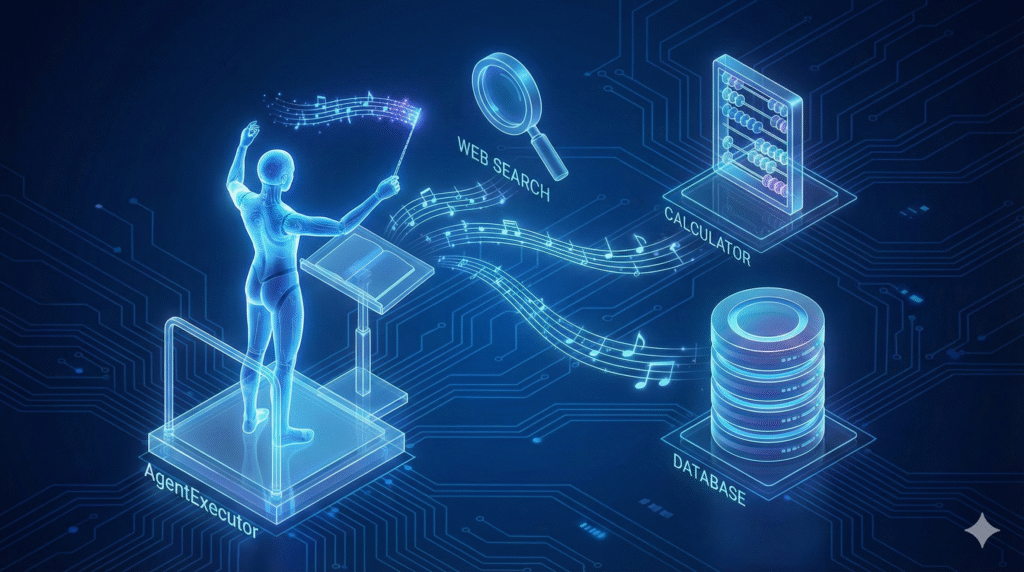
In the rapidly evolving world of artificial intelligence, building agents that can reason, make decisions, and use tools has become essential. At the heart of this capability lies a powerful component called AgentExecutor. Whether you’re developing chatbots, automation systems, or complex AI workflows, understanding AgentExecutor is crucial for creating intelligent, tool-using AI applications. What is AgentExecutor? AgentExecutor is a smart controller in LangChain that runs agent-based workflows powered by large language models and external tools. Rather than simply generating text responses, AgentExecutor enables your AI to think strategically, use tools dynamically, and solve complex multi-step problems. Think of AgentExecutor as a conductor orchestrating an AI symphony. It manages the entire lifecycle of an agent’s decision-making process, from receiving a query to delivering a final answer while intelligently calling various tools along the way. Why Do You Need AgentExecutor? Traditional language models are limited to generating text based on their training data. But what happens when you need your AI to: AgentExecutor allows your AI to behave like a reasoning assistant that can use tools to solve complex, multi-step queries. It bridges the gap between simple text generation and true AI agents that can interact with the world. How AgentExecutor Works: The Core Mechanism The AgentExecutor orchestrates the execution of agents by calling them, executing returned actions, and then calling them again with the result of executed actions. This iterative process continues until a final answer is reached. The execution loop follows this pattern: This cycle repeats until the agent either finds a satisfactory answer or reaches a maximum iteration limit. Key Components of AgentExecutor 1. The Agent The agent is the brain of the operation, powered by a large language model. It analyzes the task, reasons about the best approach, and decides which tools to invoke. 2. Tools Tools are functions or capabilities that the agent can use. Examples include: 3. Memory (Optional) Memory allows the agent to maintain context across interactions, enabling conversational experiences. 4. Iteration Control AgentExecutor includes safeguards like maximum iterations to prevent infinite loops and control execution costs. Building Your First AgentExecutor: A Practical Example Here’s how to create a basic AgentExecutor in LangChain: Common Use Cases for AgentExecutor 1. Research Assistants Build agents that can search multiple sources, synthesize information, and provide comprehensive answers with citations. 2. Data Analysis Agents Create agents that can query databases, perform calculations, and generate insights from complex datasets. 3. Customer Support Automation Deploy agents that can look up customer information, search knowledge bases, and resolve issues autonomously. 4. Workflow Automation Develop agents that orchestrate multi-step business processes, making decisions and calling appropriate services along the way. Advanced AgentExecutor Features Streaming Responses AgentExecutor adapts its behavior based on workflow execution mode, emitting incremental events as the agent produces tokens during streaming. Error Handling AgentExecutor provides robust error handling mechanisms to gracefully manage tool failures and parsing errors. Custom Agent Types Beyond the standard ReAct (Reasoning + Action) pattern, you can implement custom agent logic to suit specific requirements. State Management For complex applications, AgentExecutor can maintain and update state throughout the execution process. Best Practices for Using AgentExecutor 1. Set Appropriate Iteration Limits Prevent runaway agents by setting reasonable max_iterations values based on your use case. 2. Enable Verbose Mode During Development Use verbose=True to understand exactly what your agent is doing at each step. 3. Implement Robust Error Handling Always set handle_parsing_errors=True to gracefully handle unexpected agent outputs. 4. Optimize Tool Descriptions Clear, concise tool descriptions help the agent make better decisions about when to use each tool. 5. Monitor and Log Agent Behavior Use LangSmith or similar tools to trace agent execution and identify optimization opportunities. AgentExecutor vs. Traditional Programming Traditional Approach AgentExecutor Approach Fixed workflow logic Dynamic decision-making Hard-coded tool selection AI-driven tool selection Limited adaptability Adapts to various inputs Requires explicit programming Natural language instructions Common Challenges and Solutions Challenge 1: Agent Uses Wrong Tools Solution: Improve tool descriptions and provide few-shot examples in your prompts. Challenge 2: Infinite Loops Solution: Set conservative max_iterations and implement proper stopping conditions. Challenge 3: Expensive API Calls Solution: Implement caching, use streaming, and optimize your prompts to reduce iterations. Challenge 4: Inconsistent Outputs Solution: Lower temperature settings and use structured output formats. The Future of AgentExecutor The AI agent ecosystem is evolving rapidly. LangChain’s newer framework, LangGraph, builds upon AgentExecutor concepts while providing more granular control and advanced features like: However, AgentExecutor remains an excellent starting point for developers new to AI agents and continues to be suitable for many production use cases. Getting Started Today Ready to build your first intelligent agent? Here’s your roadmap: Conclusion AgentExecutor represents a paradigm shift in how we build AI applications. By enabling language models to reason about problems, select appropriate tools, and iterate toward solutions, it unlocks possibilities that were previously out of reach. Whether you’re building a simple question-answering bot or a complex autonomous system, understanding AgentExecutor is essential for modern AI development. The key is to start simple, experiment freely, and gradually increase complexity as you master the fundamentals. The future of AI isn’t just about better language models—it’s about intelligent agents that can think, act, and solve real-world problems. AgentExecutor is your gateway to that future.

agentic ai
Artifical Intelligence

Agentic AI: How Autonomous AI Agents Are Transforming Business Operations in 2025

Introduction The business landscape is experiencing a seismic shift with the emergence of Agentic AI—autonomous artificial intelligence systems that can plan, make decisions, and take actions independently to achieve user-defined goals. Unlike traditional AI that merely responds to prompts, Agentic AI proactively identifies problems, formulates strategies, and executes solutions without constant human oversight. Industry analysts predict that by 2028, approximately 15% of organizational work decisions will be made autonomously by AI agents. This transformative technology is reshaping how businesses operate, compete, and deliver value to customers. In this comprehensive guide, we’ll explore what Agentic AI is, how it works, its real-world applications, implementation strategies, and how your organization can leverage this revolutionary technology to gain competitive advantages. What is Agentic AI? Agentic AI refers to artificial intelligence systems designed with agency—the ability to act independently, make autonomous decisions, and pursue goals with minimal human intervention. These intelligent agents can perceive their environment, process complex information, learn from experiences, and take calculated actions to accomplish specific objectives. Key Characteristics of Agentic AI: Unlike conventional AI chatbots that respond reactively to user queries, Agentic AI systems take initiative. They analyze situations, formulate action plans, execute tasks, monitor outcomes, and adjust strategies dynamically. How Agentic AI Differs from Traditional AI Aspect Traditional AI Agentic AI Interaction Reactive, responds to prompts Proactive, initiates actions Decision-making Limited to predefined rules Autonomous, context-aware choices Task Complexity Single-step responses Multi-step workflow execution Learning Static after training Continuous adaptation Goal Achievement Requires human guidance Independent goal pursuit Planning No planning capability Strategic planning and execution Core Technologies Powering Agentic AI Agentic AI combines multiple advanced technologies: 1. Large Language Models (LLMs) Foundation models like GPT-4, Claude, and Gemini provide natural language understanding, reasoning capabilities, and knowledge synthesis. 2. Reinforcement Learning Enables agents to learn optimal behaviors through trial-and-error interactions with their environment, receiving rewards for successful actions. 3. Multi-Agent Systems Coordinated networks of specialized AI agents that collaborate, share information, and divide complex tasks efficiently. 4. Tool Integration APIs Connections to databases, software applications, IoT devices, and external systems that agents can manipulate to accomplish tasks. 5. Memory Systems Short-term and long-term memory architectures that allow agents to maintain context, recall past interactions, and build knowledge over time. 6. Planning Algorithms Sophisticated techniques like Monte Carlo Tree Search and hierarchical planning that enable agents to strategize multi-step solutions. Real-World Applications of Agentic AI 1. Customer Service Automation Agentic AI customer service agents can: Business Impact: Companies report 40-60% reduction in customer service costs while improving response times and customer satisfaction scores. 2. Supply Chain Optimization AI agents autonomously: Business Impact: Organizations achieve 15-25% reduction in supply chain costs and 30-40% improvement in inventory accuracy. 3. Financial Trading and Analysis Financial AI agents: Business Impact: Faster execution speeds, reduced emotional bias, and 24/7 market monitoring capabilities. 4. Software Development Development AI agents: Business Impact: Development teams report 30-50% productivity increases and faster time-to-market. 5. Healthcare Diagnostics Medical AI agents: Business Impact: Earlier disease detection, reduced diagnostic errors, and improved patient outcomes. 6. Marketing Campaign Management Marketing AI agents: Business Impact: 20-35% improvement in campaign ROI and significant time savings for marketing teams. Benefits of Implementing Agentic AI 1. Enhanced Operational Efficiency AI agents work continuously without breaks, handling repetitive tasks faster and more accurately than humans, freeing employees for strategic work. 2. Scalability Organizations can scale operations without proportional increases in headcount. AI agents handle surges in demand seamlessly. 3. Cost Reduction Automation of routine tasks reduces labor costs while maintaining or improving quality standards. 4. Improved Decision-Making AI agents analyze vast amounts of data quickly, identifying patterns and insights humans might miss, leading to better-informed decisions. 5. 24/7 Operations Unlike human workers, AI agents operate around the clock, enabling continuous business operations and faster response times. 6. Consistency and Accuracy AI agents follow procedures precisely, reducing errors caused by human fatigue, distraction, or inconsistency. 7. Personalization at Scale AI agents can deliver individualized experiences to thousands or millions of customers simultaneously. Challenges and Considerations 1. Trust and Reliability Organizations must ensure AI agents make appropriate decisions, especially in high-stakes scenarios requiring human judgment and ethical considerations. 2. Governance and Compliance Implementing AI governance frameworks to manage legal, ethical, and operational performance is essential. Companies need clear policies on AI decision-making authority and accountability. 3. Integration Complexity Connecting AI agents to existing systems, databases, and workflows requires significant technical expertise and can be time-consuming. 4. Data Quality and Security AI agents depend on high-quality data. Poor data leads to poor decisions. Additionally, organizations must protect sensitive information from unauthorized agent access. 5. Transparency and Explainability Understanding why an AI agent made specific decisions is crucial for troubleshooting, compliance, and building user trust. 6. Change Management Employees may resist AI implementation due to job security concerns. Effective change management and training programs are essential. Implementation Strategy for Agentic AI Phase 1: Assessment and Planning Step 1: Identify Use Cases Step 2: Evaluate Readiness Step 3: Define Success Metrics Phase 2: Pilot Implementation Step 4: Start Small Step 5: Build Infrastructure Step 6: Train and Monitor Phase 3: Scaling and Optimization Step 7: Expand Gradually Step 8: Establish Governance Step 9: Continuous Improvement Best Practices for Agentic AI Success 1. Maintain Human Oversight Critical decisions should require human approval, especially in areas affecting safety, privacy, or significant financial impact. 2. Invest in Data Quality Ensure data is accurate, complete, current, and properly labeled. Garbage in equals garbage out. 3. Design for Transparency Build systems that can explain agent reasoning and decision-making processes to stakeholders. 4. Prioritize Security Implement robust authentication, authorization, and encryption to protect systems from unauthorized agent access. 5. Focus on User Experience Design agent interactions to be natural, helpful, and aligned with user expectations and preferences. 6. Establish Clear Boundaries Define explicit limits on agent authority and decision-making scope to prevent unintended consequences. 7. Create Feedback Loops Enable users to rate agent performance and provide corrections that improve future behavior. The Future of Agentic AI The trajectory

Scroll to Top