
AI and Software Development Company | Tech Biz Builders

AI Automation

AI, AI Tools

AI Agent vs AI Automation: Benefits, Use Cases, and Implementation Tips

AI Agent vs AI Automation: Benefits, Use Cases, and Implementation Tips Are you feeling overwhelmed by the buzz around Artificial Intelligence? It’s not just about chatbots anymore. The lines between AI automation and AI agents are becoming increasingly blurred, leading to confusion about which technology is right for your business. Many companies are struggling to understand the nuances and realize the full potential of these tools. This article will break down the key differences between AI agents and AI automation, exploring their respective benefits, practical use cases, and offering actionable tips for successful implementation. We’ll delve into how each approach can streamline operations, boost productivity, and ultimately drive growth. By the end, you’ll have a clear understanding of how to strategically leverage AI to achieve your specific business goals – whether that’s automating repetitive tasks or creating truly intelligent, self-directed systems. | AI Agent vs AI Automation Understanding AI Automation AI automation refers to the use of software and algorithms to perform repetitive, rule-based tasks without human intervention. Think of it as automating existing processes. It’s about taking a well-defined workflow – like data entry, invoice processing, or generating reports – and replacing manual steps with automated solutions. Robotic Process Automation (RPA) is a common form of AI automation, utilizing software robots to mimic human actions within digital systems. Traditionally, automation required significant upfront programming and a rigid, pre-defined structure. However, modern AI-powered automation tools are becoming more adaptable and can handle variations within a process, making them more efficient and less reliant on complex scripting. For example, a marketing team might use AI automation to automatically send personalized email sequences based on customer behavior, or a customer service department could automate the routing of support tickets to the appropriate agent. The key here is consistency and predictability – automating tasks that follow a clear, established pattern. Benefits of AI Automation Implementing AI automation offers a multitude of advantages. Firstly, it dramatically increases efficiency by reducing the time and resources required to complete tasks. Secondly, it minimizes human error, leading to improved data accuracy and reduced operational costs. Thirdly, it frees up human employees to focus on more strategic and creative work, boosting overall productivity. Furthermore, automation provides greater scalability – you can easily handle increased workloads without hiring additional staff. According to a McKinsey report, businesses that successfully implement automation can see productivity gains of up to 30%. Finally, automation improves compliance by ensuring consistent adherence to established procedures. Consider a logistics company automating warehouse inventory management – this reduces stockouts, minimizes waste, and streamlines the entire supply chain. Use Cases for AI Automation The applications of AI automation are incredibly diverse. Here are a few common examples: Finance: Automating invoice processing, reconciliation, and fraud detection. Customer Service: Automating responses to frequently asked questions, routing support tickets, and providing basic troubleshooting. Human Resources: Automating onboarding processes, benefits enrollment, and payroll. Marketing: Automating email marketing campaigns, social media scheduling, and lead generation. Operations: Automating data entry, report generation, and supply chain management. Delving into AI Agents AI agents, on the other hand, represent a more advanced form of AI. They are designed to perceive their environment, make decisions, and take actions to achieve specific goals – often without explicit human instruction. Unlike automation, which follows pre-programmed rules, AI agents learn and adapt over time. They utilize techniques like reinforcement learning and natural language processing to understand complex situations and respond intelligently. Think of them as digital assistants that can proactively solve problems and manage tasks. A key difference is their ability to handle ambiguity and unexpected events. Instead of simply executing a predefined script, an AI agent can analyze the situation, assess the potential consequences, and choose the best course of action. For instance, an AI agent in a smart home could learn your preferences and automatically adjust the temperature, lighting, and entertainment system – all without you having to manually control them. Key Characteristics of AI Agents AI agents possess several defining characteristics: Autonomy: They can operate independently and make decisions without constant human oversight. Learning: They continuously learn from their experiences and improve their performance over time. Adaptability: They can adjust to changing environments and unexpected situations. Goal-Oriented: They are designed to achieve specific objectives. Perception: They can gather information about their surroundings through sensors and data. Examples of AI Agent Applications AI agents are already being used in a growing number of industries. Here are some notable examples: Application Description Benefit Virtual Assistants (Siri, Alexa, Google Assistant) Respond to voice commands, provide information, and control smart home devices. Convenience, accessibility, hands-free operation. Trading Bots Analyze market data and execute trades automatically. Increased speed, reduced emotional bias, 24/7 operation. Autonomous Vehicles Navigate and operate vehicles without human intervention. Improved safety, reduced traffic congestion, increased efficiency. Personalized Healthcare Assistants Monitor patient health, provide medication reminders, and schedule appointments. Improved patient outcomes, reduced healthcare costs, increased patient engagement. Choosing the Right Approach: AI Agent vs. AI Automation So, which is right for you? AI automation is best suited for tasks that are repetitive, rule-based, and well-defined. It’s a solid choice for streamlining existing processes and improving efficiency. AI agents, however, are more appropriate for situations that require adaptability, learning, and decision-making. They excel at handling complex, dynamic environments where pre-programmed rules are insufficient. Often, the most effective strategy involves a combination of both. You might use AI automation to handle routine tasks and AI agents to manage more complex, strategic initiatives. Consider a scenario where an AI agent monitors customer feedback and automatically escalates critical issues to a human agent – this combines the efficiency of automation with the intelligence of an agent. Ultimately, the best approach depends on your specific business needs, goals, and resources. Conclusion Both AI agents and AI automation offer significant opportunities for businesses to improve efficiency, reduce costs, and drive growth. AI automation excels at streamlining repetitive tasks, while AI agents provide the ability to learn, adapt, and make intelligent decisions. Understanding the distinctions


AI, AI Automation

Unlocking the Power of Claude: Your Ultimate Free AI Agent for Smarter Tasks

Unlocking the Power of Claude: Your Ultimate Free AI Agent for Smarter Tasks Feeling overwhelmed by endless to-do lists and information overload? In today’s fast-paced world, staying productive and efficient can feel like a constant battle. But what if you had a powerful AI assistant readily available to streamline your workflows, boost your creativity, and tackle complex tasks with ease? Enter Claude, a cutting-edge AI model rapidly gaining popularity for its intelligence and versatility. This comprehensive guide will unveil the power of Claude, showing you how to leverage this incredible free AI agent to become significantly smarter and more productive. We’ll explore its capabilities, practical use cases, and tips to maximize your results. Get ready to unlock a new level of efficiency! | Claude AI Agent What is Claude and Why is it a Game-Changer? Claude is a large language model (LLM) created by Anthropic, a company focused on AI safety and beneficial AI. Unlike some other AI tools, Claude is designed to be helpful, harmless, and honest. It excels at a wide range of tasks, from writing and summarizing to coding and answering complex questions. What truly sets Claude apart is its focus on safety and its ability to generate more nuanced and less biased responses than some of its competitors. This makes it a reliable and trustworthy tool for a variety of applications. Its open-weights availability means developers can integrate it into their own applications, further expanding its potential. Core Capabilities of Claude Claude’s core capabilities cover a broad spectrum of tasks. Here’s a quick overview: Text Generation: Producing high-quality articles, stories, poems, and more. Summarization: Condensing lengthy documents into concise summaries. Code Generation: Writing code in various programming languages. Question Answering: Providing accurate and informative answers to complex questions. Creative Writing: Assisting with brainstorming, plot development, and character creation. Data Analysis: Helping to interpret data and identify trends (when provided with data). Example: Imagine needing to write a blog post about the benefits of meditation. Claude can generate a complete draft, saving you hours of writing time. Boosting Productivity with Claude: Practical Use Cases Claude isn’t just a theoretical tool; it’s a powerful asset for real-world productivity. Here are some practical ways you can use Claude to enhance your workflow: Content Creation & Marketing Content creation is often a time-consuming process. Claude can assist with various stages, from generating outlines and writing drafts to optimizing content for SEO. It can also help you brainstorm ideas, research topics, and even create engaging social media posts. Furthermore, Claude can help you rewrite existing content to improve clarity and impact. This frees you up to focus on higher-level strategic tasks. Example: Generating Social Media Captions Provide Claude with the key points of a blog post and ask it to generate several catchy captions for different social media platforms. This provides instant inspiration and can save you valuable time. Statistics show that businesses utilizing AI for content creation see a 30% increase in content output. Research & Information Gathering Need to find information on a specific topic? Claude can quickly sift through vast amounts of data and provide you with relevant insights. It can summarize research papers, identify key trends, and answer complex questions. This is particularly useful for students, researchers, and anyone who needs to stay informed. Claude can also help you synthesize information from multiple sources, offering a comprehensive overview of the topic. Example: Summarizing a Research Paper Paste the text of a research paper into Claude and ask it to provide a concise summary of the key findings. This allows you to quickly grasp the essence of the research without having to read the entire paper. Leveraging Claude for Coding and Technical Tasks Claude’s ability to generate code has made it a valuable tool for developers and programmers. It can help you write code snippets in various programming languages, debug existing code, and even generate entire programs from scratch. Its understanding of code syntax and logic allows it to produce surprisingly accurate and functional code. While it’s not a replacement for a skilled programmer, Claude can significantly accelerate the coding process and help you tackle complex technical challenges. Code Generation and Debugging Provide Claude with a description of the desired functionality, and it will generate the corresponding code. If you have an existing code snippet that isn’t working, you can paste it into Claude and ask it to identify and fix the errors. This can save you a significant amount of debugging time. Example: Generating Python Code for Data Analysis Ask Claude to generate Python code to analyze a CSV file and calculate various statistics. This can be a quick and easy way to get started with data analysis without having to write the code from scratch. Many developers are using Claude to automate repetitive coding tasks, leading to increased efficiency and reduced errors. Enhancing Creativity and Brainstorming with Claude Feeling stuck in a creative rut? Claude can be an invaluable brainstorming partner. It can help you generate ideas, explore different perspectives, and overcome creative blocks. You can use it to generate story ideas, develop marketing campaigns, or simply explore new possibilities. Its ability to generate unexpected and imaginative responses can often spark fresh insights and lead to innovative solutions. Idea Generation and Storytelling Provide Claude with a basic concept, and it will generate a range of ideas related to that concept. You can then use these ideas as a starting point for your own creative work. Claude can also help you develop characters, plot points, and dialogue for stories. It’s a great tool for writers, artists, and anyone who wants to explore their creative potential. Example: Generating Story Prompts Ask Claude to generate a list of story prompts based on a specific genre, such as science fiction or fantasy. This can help you overcome writer’s block and get your creative juices flowing. Conclusion: Harnessing the Power of Free AI with Claude Claude represents a significant leap forward in AI accessibility and capabilities. Its free availability removes

AI Agent, AI Automation

AI Agent vs AI Automation: Which Boosts Business Efficiency More?

AI Agent vs AI Automation: Which Boosts Business Efficiency More? Are you feeling overwhelmed by the sheer volume of tasks consuming your team’s time? Do you dream of a business that operates with seamless efficiency, freeing up your employees to focus on strategic initiatives? Artificial intelligence (AI) is rapidly transforming the business landscape, offering solutions to streamline operations and drive growth. However, the terms “AI agent” and “AI automation” are often used interchangeably, leading to confusion about which approach truly delivers the most significant boost to business efficiency. This article will delve into the nuances of these two AI technologies, exploring their distinct capabilities, benefits, and ultimately, which one is better suited to elevate your organization’s performance. We’ll equip you with the knowledge to make informed decisions about investing in AI and maximizing its impact on your bottom line. Let’s break down the differences and discover how to strategically implement AI for lasting success. | AI agent vs AI automation Understanding AI Automation AI automation refers to the use of AI technologies – primarily Robotic Process Automation (RPA) – to automate repetitive, rule-based tasks. Think of it as teaching a computer to mimic human actions, such as data entry, invoice processing, or generating reports. RPA bots can interact with existing software applications, mimicking a human user’s actions, without requiring any changes to the underlying systems. This is a foundational element of many businesses looking to improve efficiency. Traditionally, automation involved pre-programmed scripts and workflows, but modern RPA leverages AI to handle more complex scenarios and adapt to changing conditions. It’s about taking the *what* and the *how* out of routine processes, allowing your team to concentrate on higher-value work. For example, a retail company might automate order fulfillment using RPA, reducing errors and speeding up delivery times. A financial institution could automate account reconciliation, freeing up accountants to focus on financial analysis. Benefits of AI Automation The advantages of AI automation are substantial and well-documented. According to a McKinsey report, automating 20-30% of routine tasks could free up 20-30% of employees’ time. This translates directly into increased productivity and reduced operational costs. Here’s a breakdown of key benefits: Reduced Errors: RPA bots are programmed to execute tasks precisely, minimizing human error. Increased Efficiency: Automation speeds up processes, leading to faster turnaround times. Cost Savings: Reduced labor costs and fewer errors contribute to significant cost savings. Improved Compliance: Automation ensures adherence to regulations and internal policies. Scalability: RPA solutions can easily scale to meet changing business needs. Examples of AI Automation in Action Several industries are already reaping the rewards of AI automation. Consider these examples: Healthcare: Automating patient scheduling and insurance claims processing. Manufacturing: Optimizing supply chain management and quality control. Customer Service: Implementing chatbots for initial customer inquiries. Human Resources: Automating onboarding processes and payroll. Delving into AI Agents AI agents, on the other hand, represent a more advanced form of AI. Unlike automation, which focuses on executing pre-defined tasks, AI agents are designed to *learn* and *adapt* to new situations. They operate autonomously, making decisions and taking actions based on their understanding of the environment. Think of them as digital assistants that can proactively solve problems and improve outcomes. These agents utilize technologies like natural language processing (NLP), machine learning (ML), and computer vision to perceive their surroundings, understand user intent, and take appropriate action. They’re not just following instructions; they’re reasoning and responding. How AI Agents Differ from Traditional Automation The key difference lies in the level of intelligence and adaptability. Automation is reactive – it responds to specific triggers. AI agents are proactive – they anticipate needs and take initiative. Here’s a table summarizing the key distinctions: Feature AI Automation (RPA) AI Agent Intelligence Level Low – Rule-based High – Learning and Adaptive Decision Making Pre-defined Autonomous Task Type Repetitive, Rule-based Complex, Dynamic Adaptability Limited High Use Cases for AI Agents AI agents are finding applications in a growing number of areas. Here are a few compelling examples: Personalized Customer Experiences: AI agents can analyze customer data to provide tailored recommendations and support. Intelligent Virtual Assistants: Agents can handle complex customer inquiries and resolve issues without human intervention. Predictive Maintenance: Agents can monitor equipment performance and predict potential failures. Autonomous Trading: Agents can execute trades based on market analysis and predefined strategies. Which Boosts Business Efficiency More: Agent or Automation? Determining whether AI agents or AI automation are more effective for boosting business efficiency depends heavily on the specific needs and goals of your organization. AI automation excels at streamlining repetitive tasks and reducing operational costs – it’s a powerful tool for optimizing existing processes. However, it’s limited in its ability to handle complex, dynamic situations. AI agents, on the other hand, offer a more holistic approach, enabling businesses to adapt to changing conditions and proactively improve outcomes. While implementation costs may be higher, the long-term benefits of increased agility and innovation can be substantial. Often, the most effective strategy involves a *combination* of both technologies – leveraging automation for routine tasks and deploying AI agents to tackle more complex challenges. A successful implementation requires careful planning, a clear understanding of your business needs, and a phased approach to adoption. Ultimately, the best choice isn’t about which is “better,” but about which is “right for you.” Consider your current processes, your strategic priorities, and your willingness to invest in more sophisticated AI solutions. By carefully evaluating your options and developing a well-defined AI strategy, you can unlock the full potential of AI to transform your business and drive sustainable growth. Investing in AI, whether through automation or agents, is no longer a luxury – it’s a necessity for businesses seeking to thrive in today’s competitive landscape. Don’t get left behind. Start exploring the possibilities and discover how AI can revolutionize your operations and propel your business forward. Image by: Markus Winkler

AI Agent, AI Automation

Understanding the Difference Between AI Agents and AI Automation for SEO Success

Understanding the Difference Between AI Agents and AI Automation for SEO Success Are you feeling overwhelmed by the constant buzz around Artificial Intelligence and its impact on SEO? It’s easy to get lost in the hype, with terms like “AI agents” and “AI automation” thrown around without a clear understanding of what they actually *do*. Many marketers are struggling to determine which tools will truly deliver results for their SEO strategies. The truth is, while both leverage AI, they operate in fundamentally different ways. This article will break down the distinctions between AI agents and AI automation, providing you with a practical guide to understanding how to strategically implement these technologies to boost your search engine rankings. We’ll explore how each approach can be applied to SEO tasks, highlighting the benefits and limitations of each, ultimately helping you make informed decisions about your investment in AI. | AI agents vs AI automation SEO AI Automation: Streamlining Repetitive SEO Tasks AI automation focuses on automating pre-defined tasks – essentially, taking the repetitive, manual work out of your SEO workflow. Think of it as building a robot to handle the mundane. This approach is incredibly valuable for scaling your SEO efforts and freeing up your team to focus on more strategic initiatives. Traditionally, SEO involved countless hours spent on tasks like data scraping, report generation, and basic content optimization. AI automation tools are now capable of handling these tasks with remarkable speed and accuracy. For example, tools like Surfer SEO’s AI features can automatically analyze competitor content and suggest keyword variations, content structure improvements, and even readability adjustments. Similarly, Rank Tracking tools now utilize AI to predict ranking changes based on algorithm updates and competitor activity. Examples of AI Automation in SEO Here are some specific examples of how AI automation is being used in SEO today: Keyword Research: AI tools can automatically identify related keywords, analyze search volume trends, and assess keyword difficulty. Content Optimization: AI can analyze your existing content and suggest improvements for readability, keyword density, and overall SEO performance. Link Building: Some tools are starting to automate outreach to potential link partners, although this requires careful monitoring and personalization. Report Generation: AI can automatically generate comprehensive SEO reports, tracking key metrics and identifying areas for improvement. Schema Markup Generation: AI can assist in creating and implementing schema markup to improve your website’s visibility in search results. While AI automation is powerful, it’s crucial to remember that it operates within predefined parameters. It can’t think creatively or adapt to unexpected changes in the search landscape. It excels at consistency and efficiency, but it lacks the strategic intuition of a human SEO specialist. A recent study by HubSpot found that businesses using AI automation for content optimization saw an average increase of 15% in organic traffic within six months – a testament to its effectiveness when applied correctly. AI Agents: Intelligent, Adaptive SEO Assistants AI agents, on the other hand, represent a more advanced and dynamic approach to AI in SEO. Unlike automation, which follows pre-programmed instructions, AI agents are designed to learn, adapt, and make decisions independently. They’re essentially virtual assistants that can proactively monitor your website, analyze data, and take action to improve your SEO performance – often without explicit instructions. These agents utilize techniques like reinforcement learning and natural language processing to understand the nuances of your website and the broader search environment. They’re not just executing tasks; they’re *learning* how to optimize your SEO strategy over time. How AI Agents Differ from Traditional Automation Here’s a table highlighting the key differences: Feature AI Automation AI Agent Operation Follows pre-defined rules Learns and adapts Decision-Making Limited to programmed instructions Proactive and autonomous Data Analysis Static analysis based on historical data Dynamic analysis incorporating real-time data Example Automated keyword research tool An agent that automatically adjusts content based on user behavior and search trends Consider an AI agent monitoring your website’s performance. Instead of simply reporting on existing rankings, it might identify a sudden drop in organic traffic and automatically investigate potential causes – such as a recent Google algorithm update or a competitor’s aggressive SEO campaign. It could then suggest content adjustments, link building opportunities, or technical fixes to address the issue. This proactive approach is what sets AI agents apart and allows them to deliver more impactful results. A case study by BrightEdge showed that companies using AI agents for website optimization saw an average of 20% improvement in their core web vitals – a critical factor for Google rankings. Combining Automation and Agents for Optimal SEO Results The most effective SEO strategies will likely involve a combination of both AI automation and AI agents. Automation can handle the foundational tasks – like keyword research and content optimization – while agents can take a more strategic and proactive role in monitoring performance and adapting to changes. Think of automation as building the framework and agents as adding the intelligence and adaptability to that framework. For example, you could use an AI automation tool to generate a list of potential keywords, and then an AI agent could analyze the competition for those keywords and suggest the most promising targets for your content strategy. This synergistic approach allows you to leverage the strengths of both technologies to achieve maximum SEO impact. Moving forward, the integration of AI into SEO will only become more sophisticated. As AI technology continues to evolve, we can expect to see even more powerful tools and techniques emerge that will transform the way we approach search engine optimization. Staying informed about these developments and strategically implementing the right AI solutions will be crucial for maintaining a competitive edge in the ever-changing world of online search. In conclusion, while AI automation streamlines repetitive tasks, AI agents offer a more intelligent and adaptive approach to SEO. By combining these technologies, marketers can unlock significant improvements in their search engine rankings and drive sustainable organic growth. Don’t just react to changes in the SEO landscape –

AI, AI Automation

From AI Agents to AI Automation: A Complete Guide to Smarter Workflows

From AI Agents to AI Automation: A Complete Guide to Smarter Workflows Are you feeling overwhelmed by your daily tasks? Do you spend countless hours on repetitive processes, leaving you little time for strategic thinking and creative work? The rise of artificial intelligence (AI) is no longer a futuristic concept – it’s a present-day reality transforming how we work. Many businesses are struggling to understand the difference between AI agents and AI automation, and how to effectively leverage these technologies to boost productivity and efficiency. This guide will break down the nuances of both, providing a clear roadmap to implementing smarter workflows and unlocking the true potential of AI. You’ll learn how to identify opportunities for automation, understand the capabilities of AI agents, and ultimately, build a more streamlined and productive work environment. We’ll cover practical strategies, real-world examples, and actionable tips to help you navigate this exciting new landscape – regardless of your technical expertise. | AI Agents and AI Automation Understanding AI Agents: Your Intelligent Assistants AI agents represent a significant shift in how we interact with technology. Unlike traditional automation, which follows pre-programmed rules, AI agents possess a degree of autonomy and can learn and adapt to changing circumstances. They’re essentially digital assistants that can perform tasks, answer questions, and even make decisions – all without constant human intervention. Think of them as specialized software programs that mimic human intelligence, capable of understanding natural language and responding in a contextually relevant manner. These agents aren’t just about executing commands; they’re about understanding *why* a command is given and responding accordingly. This is achieved through techniques like Natural Language Processing (NLP) and Machine Learning (ML). Key Capabilities of AI Agents Natural Language Understanding (NLU): Agents can interpret and understand human language, even with variations in phrasing or tone. Task Execution: They can perform a wide range of tasks, from scheduling meetings to generating reports. Learning and Adaptation: Through ML, agents continuously improve their performance based on user interactions and data analysis. Personalization: Agents can tailor their responses and recommendations to individual user preferences. A compelling example of an AI agent in action is a customer service chatbot. Instead of simply providing pre-written answers, a sophisticated chatbot can understand the customer’s issue, access relevant information, and offer personalized solutions. According to a recent report by Gartner, AI agents are projected to handle 85% of customer interactions by 2025. This demonstrates the growing demand and potential of this technology. Furthermore, AI agents are increasingly being used in internal operations, assisting employees with research, data analysis, and even drafting emails – freeing up valuable time for more strategic work. Delving into AI Automation: Streamlining Processes AI automation goes beyond simple task execution; it focuses on automating entire workflows and processes. This involves using AI technologies – such as Robotic Process Automation (RPA) combined with AI – to mimic human actions within software applications. RPA bots, often referred to as “digital workers,” can be programmed to perform repetitive, rule-based tasks, like data entry, invoice processing, and report generation. However, the true power of AI automation lies in its ability to *learn* and adapt these rules, moving beyond rigid scripting to handle more complex and dynamic scenarios. This is where the integration of AI, particularly machine learning, becomes crucial. Types of AI Automation RPA (Robotic Process Automation): Automates repetitive, rule-based tasks. Intelligent Document Processing (IDP): Uses AI to extract data from unstructured documents like invoices and contracts. Process Mining: Analyzes existing workflows to identify automation opportunities. Cognitive Automation: Combines RPA with AI to automate more complex, decision-making processes. Consider a logistics company. Traditionally, tracking shipments involved manual data entry and phone calls. Now, an AI-powered automation system can automatically scan shipping labels, update tracking information in real-time, and proactively notify customers of any delays – all without human intervention. This not only reduces errors and improves efficiency but also significantly lowers operational costs. A case study by McKinsey found that companies implementing AI automation can see a 20-30% increase in productivity and a 15-25% reduction in operational costs. The key is to start with well-defined, repetitive processes and gradually expand automation efforts as the technology matures. Bridging the Gap: AI Agents vs. AI Automation It’s important to distinguish between AI agents and AI automation, as they serve different purposes. AI agents are designed to *assist* humans, while AI automation is designed to *replace* human tasks. Think of an AI agent as a helpful colleague, and AI automation as a tireless worker. While they can often work together – for example, an AI agent might trigger an automation workflow – they are fundamentally different concepts. The most effective strategies often involve a hybrid approach, leveraging the strengths of both to create truly intelligent workflows. Feature AI Agents AI Automation Focus Human Assistance Task Replacement Autonomy Moderate – Learns and Adapts High – Executes Pre-defined Rules Interaction Style Natural Language Rule-Based Typical Use Cases Customer Service, Research, Content Generation Data Entry, Invoice Processing, Report Generation For instance, a marketing team could use an AI agent to generate initial drafts of social media posts, and then use AI automation to schedule and publish those posts across various platforms. This combination of agent and automation allows for both creativity and efficiency. Ultimately, the best approach depends on the specific needs and goals of the organization. Investing in a pilot project to test both AI agents and AI automation is a crucial step in determining the optimal strategy. Conclusion: Embracing the Future of Work The convergence of AI agents and AI automation is fundamentally reshaping the way we work, offering unprecedented opportunities for increased productivity, reduced costs, and improved employee satisfaction. AI agents provide intelligent assistance, while AI automation streamlines processes, creating a powerful synergy that can transform entire organizations. As AI technology continues to evolve, it’s crucial for businesses to embrace these advancements and strategically integrate them into their workflows. Don’t view AI as a threat, but rather as a tool to augment human capabilities and

AI, AI Tools

Claud Free AI Agent: Revolutionizing Intelligent Assistance at No Cost

Are you tired of expensive AI solutions that promise the world but deliver underwhelming results? Do you yearn for a truly intelligent assistant without breaking the bank? You’re not alone. The demand for readily available, powerful AI is skyrocketing, but many businesses and individuals are priced out of the market by premium options. This is where Claud, the free AI agent, steps in. This article will explore Claud’s capabilities, benefits, limitations, and how it’s poised to revolutionize intelligent assistance, proving that sophisticated AI doesn’t have to come with a hefty price tag. We’ll delve into its key features, real-world applications, and how to get started – empowering you to leverage the power of AI without the financial burden. | Claud free AI agent Understanding Claud: The Power of Free AI Claud is a free-to-use AI assistant powered by the cutting-edge technology from Anthropic, the creators of Claude.ai. It’s designed to be a versatile tool capable of handling a wide range of tasks, from generating creative content to answering complex questions and even assisting with coding. Unlike other AI models that require significant subscription fees, Claud offers a generous free tier, making it accessible to a broader audience. This democratizes AI, allowing smaller businesses, startups, and individual users to harness its potential without significant investment. The core principle behind Claud’s free offering is to provide valuable AI assistance to everyone, fostering innovation and productivity across various fields. Key Features of Claud Claud boasts several impressive features that set it apart from other free AI options. These features contribute to its versatility and make it a powerful tool for various applications. One of the key strengths of Claud is its strong focus on safety and helpfulness. Anthropic has invested heavily in developing safety protocols to minimize the risk of harmful or biased outputs. This commitment to responsible AI is a significant advantage. Another notable feature is its ability to handle complex instructions and maintain context across extended conversations. This makes it ideal for tasks that require deeper understanding and nuanced responses. How Claud Works: A Quick Overview Claud operates through a simple and intuitive interface. You can access it directly through [https://claude.ai/](https://claude.ai/) or through various integrations with popular platforms. The process is straightforward: you simply type in your prompt or question, and Claud generates a response based on its training data and built-in algorithms. The power of Claud lies in its ability to analyze information, synthesize insights, and generate creative content. It doesn’t require specialized technical skills to use, making it accessible even for those with limited AI experience. Moreover, Claud is continuously being updated and improved by Anthropic, ensuring that users always have access to the latest advancements in AI technology. Real-World Applications of Claud The power of Claud extends far beyond simple text generation. Its capabilities are finding applications in a rapidly growing range of fields. For example, Claud can be used for content creation—writing blog posts, social media updates, marketing copy, and even scripts. Businesses can leverage Claud to streamline their content production process, saving time and resources. It’s also invaluable for answering customer service inquiries, generating product descriptions, and assisting with market research. Educational institutions are utilizing Claud to provide personalized learning experiences, generate practice quizzes, and assist with research tasks. This adaptability makes Claud a versatile asset for individuals and organizations alike. Boosting Productivity for Professionals Professionals across various industries can significantly boost their productivity with Claud. Imagine needing to summarize a lengthy report, brainstorm new ideas, or draft email responses quickly. Claud can handle these tasks efficiently and effectively, freeing up valuable time for more strategic work. For instance, a marketing professional could use Claud to generate multiple variations of ad copy, A/B test different messaging, and analyze the performance of marketing campaigns. This data-driven approach allows for continuous optimization and improved results. A software developer can utilize Claud to generate code snippets and assist with debugging, accelerating the development process. Application Benefit Content Creation Generate blog posts, articles, social media copy, and more Customer Service Automate responses to common inquiries and provide 24/7 support Marketing Brainstorm marketing strategies, generate ad copy variations, and analyze campaign performance Education Personalized learning, generate quizzes, and assist with research Software Development Generate code snippets and assist with debugging The Future of AI Assistance with Claud Claud represents a significant step forward in making AI accessible to all. Its free tier, coupled with its powerful capabilities, is poised to democratize the field of artificial intelligence. Anthropic is actively investing in ongoing development, promising continuous improvements in performance, safety, and functionality. Future enhancements may include improved reasoning capabilities, more sophisticated language understanding, and tighter integrations with other popular tools. As Claud evolves, it’s positioned to become an indispensable tool for individuals and businesses seeking to leverage the power of AI without the high costs associated with premium solutions. The focus on responsible AI development is particularly noteworthy, ensuring that Claud is used ethically and effectively. Open-Source Contributions and Community Involvement While Claud is free to use, Anthropic actively encourages community involvement through its open-source initiatives. Users are encouraged to contribute to the development of Claud, sharing feedback, bug reports, and even suggesting new features. This collaborative approach fosters innovation and ensures that Claud continually evolves to meet the needs of its users. Anthropic maintains a vibrant community forum where users can connect with each other, share tips and tricks, and collaborate on projects. This level of community engagement further solidifies Claud’s position as a leading free AI platform. The transparency of Claud’s development process builds trust and empowers users to shape the future of AI assistance. Limitations and Considerations While incredibly powerful, Claud isn’t without its limitations. As a free AI, it may not always match the performance of the most expensive premium options, particularly on complex or highly nuanced tasks. Users should be aware that the responses generated by Claud are based on its training data and may occasionally contain inaccuracies or biases. It’s always a good practice to

AI, AI Automation

How ChatGPT’s Free AI Agent, Claud, Is Transforming Everyday Automation

Are you tired of repetitive tasks eating up your valuable time? Do you dream of streamlining workflows and boosting productivity without breaking the bank? You’re not alone. In today’s fast-paced world, automation is no longer a luxury – it’s a necessity. Enter Claud, the groundbreaking free AI agent from Anthropic, poised to revolutionize the way we approach everyday automation. This powerful tool isn’t just another chatbot; it’s a capable assistant that can handle complex tasks, freeing you up to focus on what truly matters. In this article, we’ll explore how Claud is transforming everyday automation, uncovering its capabilities and demonstrating how you can leverage it to enhance your efficiency. | Claud AI automation Understanding Claud: Anthropic’s Powerful New AI Assistant Claud is a large language model (LLM) developed by Anthropic, a company focused on building safe and beneficial AI. Unlike some other large language models, Claud is designed with a strong emphasis on reasoning, planning, and following complex instructions. It’s built to be helpful, harmless, and honest – principles that guide its development and ensure responsible AI usage. What sets Claud apart is its free availability. Anthropic believes that AI should be accessible to everyone, and Claud exemplifies this commitment. This makes it a particularly attractive option for individuals and businesses looking to start automating tasks without significant financial investment. Key Features and Capabilities Claud boasts several impressive features that make it a valuable automation tool. These include: Complex Task Management: Claud excels at break-down complex tasks into smaller, manageable steps. Data Analysis & Summarization: It can analyze data, identify trends, and generate concise summaries. Content Creation: Craft compelling marketing copy, write emails, and generate reports. Code Generation: Generate code snippets in various programming languages. Following Instructions: Claud is highly capable of following intricate and multi-step instructions. These capabilities transform it from a simple chatbot into a powerful virtual assistant capable of significantly enhancing productivity. Automating Customer Support with Claud Customer support is a demanding area, often requiring significant human effort. Claud offers a compelling solution for automating routine queries and improving response times. Imagine automating responses to frequently asked questions, triaging incoming support tickets, and even generating personalized support messages. By integrating Claud with your existing customer service platforms (such as Zendesk or Salesforce), you can free up your human agents to handle more complex and emotionally sensitive issues. This leads to increased customer satisfaction and reduced operational costs. For example, a small e-commerce business could use Claud to automatically answer questions about shipping policies, return procedures, and product availability. This instantly improves customer service response times and reduces the workload on their support team. A study by Grand View Research projected the global customer service automation market to reach over $13.7 billion by 2027, highlighting the significant potential of AI in this area. Case Study: Automating FAQ Responses A marketing agency developed a Claud-powered chatbot to handle common client inquiries about their services. The chatbot was trained on a dataset of frequently asked questions and provided instant answers to clients 24/7. This resulted in a 30% reduction in the agency’s customer support ticket volume and a significant improvement in client satisfaction scores. The implementation was relatively straightforward, requiring minimal technical expertise. The agency was able to quickly integrate Claud into their existing website and communication channels. Boosting Productivity with Claud for Business Tasks Beyond customer support, Claud can be applied to streamline a wide range of business tasks. From data entry and report generation to meeting scheduling and email management, Claud can automate repetitive activities, allowing employees to focus on higher-value work. Consider using Claud to generate meeting agendas, summarize lengthy documents, or extract key information from invoices. By automating these tasks, businesses can save time, reduce errors, and improve overall efficiency. Task Automation Potential Data Entry Route data from various sources to spreadsheets or databases Report Generation Create reports based on data input from business systems Email Management Draft email responses, categorize emails, and manage inbox priorities Meeting Scheduling Find and book meeting times considering attendee availability Integrating Claud with Workflow Tools The power of Claud is amplified when integrated with existing workflow tools. Platforms like Zapier and Make (formerly Integromat) allow you to connect Claud to a wide range of applications, automating tasks across your entire business. For instance, you could automatically create a new task in Asana when a customer submits a support ticket through Claud, ensuring that no requests fall through the cracks. This seamless integration makes automation truly powerful. Improving Content Creation with Claud Content creation is a time-consuming aspect of most businesses, but Claud can significantly lighten the workload. Whether you’re writing marketing copy, blog posts, or social media updates, Claud can assist with generating ideas, outlining content, and even writing complete drafts. It can adapt its writing style to suit your specific needs, ensuring that your content is engaging, informative, and consistent with your brand voice. This frees up valuable time for strategic planning and creative brainstorming. For example, a small business owner could use Claud to generate different headlines for a blog post, or to draft social media captions for a new product launch. The generated content can then be refined and edited to ensure accuracy and quality. The possibilities are endless, empowering businesses to create more content with less effort. Generating Diverse Content Formats Claud isn’t limited to just writing. It can also generate different content formats, including: Social Media Posts: Tailored for different platforms (Twitter, LinkedIn, Facebook). Product Descriptions: Compelling and informative descriptions for e-commerce sites. Email Subject Lines: Catchy subject lines to increase open rates. Blog Post Outlines: Structured outlines for well-organized content. This versatility makes Claud a valuable asset for any business looking to enhance its content marketing efforts. The Future of AI-Powered Automation with Claud Claud represents a significant step forward in the evolution of AI-powered automation. Its free availability makes it accessible to a wider audience, and its strong reasoning and planning capabilities open up new possibilities for automation. As AI technology continues

AI Agents
AI Automation

Beyond the Chatbot: Why Your Business Needs a Dedicated AI Agent in 2026

In 2024, everyone was talking about ChatGPT. In 2025, we all got used to seeing “Ask AI” buttons on every app we own. But as we settle into 2026, the novelty has worn off, and business owners are asking a much tougher question(AI Agents for Business): “If this chatbot is so smart, why am I still doing all the manual work?” If you feel like your “AI tools” are just fancy search bars that talk back to you, you’re not alone. The era of the passive chatbot is ending. We are now in the age of the Autonomous AI Agent. At TechBizBuilders, we’re helping businesses move beyond conversation and into execution. Here’s why a dedicated AI agent is the competitive edge you need this year. 1. Chatbots Talk, Agents Work The biggest misconception in 2026 is that AI agents and chatbots are the same thing. They aren’t. The 2026 Difference: While a chatbot can explain your refund policy, an AI Agent can verify the purchase, process the refund in Stripe, update your inventory, and send a personalized “we’re sorry” discount code to the customer—all in seconds. 2. Solving the “Context Gap” We’ve all had that frustrating experience where a chatbot “forgets” who we are or what we asked two minutes ago. Traditional chatbots often live in a vacuum. Dedicated AI agents are built into your business ecosystem. They have “memory” and context. They know your brand voice, your current inventory, and your client’s history. Because they are integrated directly into your WordPress site or custom app, they don’t just guess—they know. 3. The “Multi-Agent” Workforce In 2026, we’re seeing a shift toward Agentic Workflows. Instead of one giant AI trying to do everything, smart businesses are deploying specialized “Digital Employees”: 4. Scalability Without the Headcount Scaling a business used to mean a massive hiring spree. That came with overhead, training periods, and management “bloat.” With AI agents, you can scale your output by 10x without adding a single desk to your office. These agents work 24/7/365. They don’t get “burnout,” and they don’t make “tired mistakes” at 4:00 PM on a Friday. They allow your human team to stop being “task-doers” and start being strategy-makers. How to Start the Shift You don’t need to replace your entire workflow overnight. At TechBizBuilders, we recommend the “One-Task Rule”: Identify the one repetitive, soul-crushing task that eats up 5 hours of your week. Whether it’s lead qualification, invoice reconciliation, or data entry—that’s where your first AI agent belongs. Is your website still just a digital business card, or is it a high-performing employee? Ready to build your first AI Agent? At TechBizBuilders, we specialize in building the “brains” behind the business. We combine expert web development with agentic AI to turn your static site into an automated powerhouse. [Book a Free Strategy Call Today] and let’s talk about which parts of your business are ready for an upgrade.

AgentExecutor
AI Automation

Understanding AgentExecutor: Building Intelligent AI Agents with LangChain

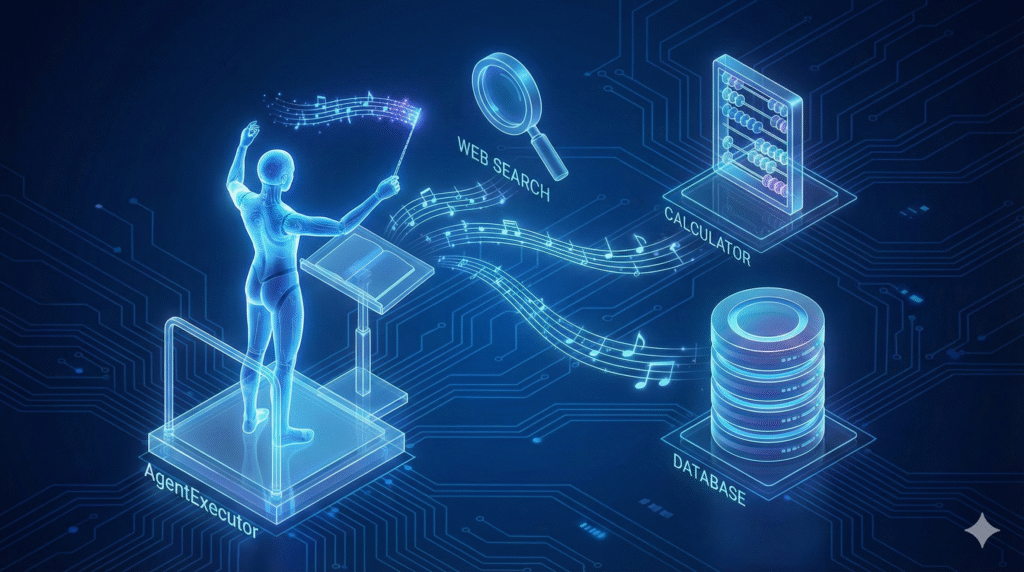
In the rapidly evolving world of artificial intelligence, building agents that can reason, make decisions, and use tools has become essential. At the heart of this capability lies a powerful component called AgentExecutor. Whether you’re developing chatbots, automation systems, or complex AI workflows, understanding AgentExecutor is crucial for creating intelligent, tool-using AI applications. What is AgentExecutor? AgentExecutor is a smart controller in LangChain that runs agent-based workflows powered by large language models and external tools. Rather than simply generating text responses, AgentExecutor enables your AI to think strategically, use tools dynamically, and solve complex multi-step problems. Think of AgentExecutor as a conductor orchestrating an AI symphony. It manages the entire lifecycle of an agent’s decision-making process, from receiving a query to delivering a final answer while intelligently calling various tools along the way. Why Do You Need AgentExecutor? Traditional language models are limited to generating text based on their training data. But what happens when you need your AI to: AgentExecutor allows your AI to behave like a reasoning assistant that can use tools to solve complex, multi-step queries. It bridges the gap between simple text generation and true AI agents that can interact with the world. How AgentExecutor Works: The Core Mechanism The AgentExecutor orchestrates the execution of agents by calling them, executing returned actions, and then calling them again with the result of executed actions. This iterative process continues until a final answer is reached. The execution loop follows this pattern: This cycle repeats until the agent either finds a satisfactory answer or reaches a maximum iteration limit. Key Components of AgentExecutor 1. The Agent The agent is the brain of the operation, powered by a large language model. It analyzes the task, reasons about the best approach, and decides which tools to invoke. 2. Tools Tools are functions or capabilities that the agent can use. Examples include: 3. Memory (Optional) Memory allows the agent to maintain context across interactions, enabling conversational experiences. 4. Iteration Control AgentExecutor includes safeguards like maximum iterations to prevent infinite loops and control execution costs. Building Your First AgentExecutor: A Practical Example Here’s how to create a basic AgentExecutor in LangChain: Common Use Cases for AgentExecutor 1. Research Assistants Build agents that can search multiple sources, synthesize information, and provide comprehensive answers with citations. 2. Data Analysis Agents Create agents that can query databases, perform calculations, and generate insights from complex datasets. 3. Customer Support Automation Deploy agents that can look up customer information, search knowledge bases, and resolve issues autonomously. 4. Workflow Automation Develop agents that orchestrate multi-step business processes, making decisions and calling appropriate services along the way. Advanced AgentExecutor Features Streaming Responses AgentExecutor adapts its behavior based on workflow execution mode, emitting incremental events as the agent produces tokens during streaming. Error Handling AgentExecutor provides robust error handling mechanisms to gracefully manage tool failures and parsing errors. Custom Agent Types Beyond the standard ReAct (Reasoning + Action) pattern, you can implement custom agent logic to suit specific requirements. State Management For complex applications, AgentExecutor can maintain and update state throughout the execution process. Best Practices for Using AgentExecutor 1. Set Appropriate Iteration Limits Prevent runaway agents by setting reasonable max_iterations values based on your use case. 2. Enable Verbose Mode During Development Use verbose=True to understand exactly what your agent is doing at each step. 3. Implement Robust Error Handling Always set handle_parsing_errors=True to gracefully handle unexpected agent outputs. 4. Optimize Tool Descriptions Clear, concise tool descriptions help the agent make better decisions about when to use each tool. 5. Monitor and Log Agent Behavior Use LangSmith or similar tools to trace agent execution and identify optimization opportunities. AgentExecutor vs. Traditional Programming Traditional Approach AgentExecutor Approach Fixed workflow logic Dynamic decision-making Hard-coded tool selection AI-driven tool selection Limited adaptability Adapts to various inputs Requires explicit programming Natural language instructions Common Challenges and Solutions Challenge 1: Agent Uses Wrong Tools Solution: Improve tool descriptions and provide few-shot examples in your prompts. Challenge 2: Infinite Loops Solution: Set conservative max_iterations and implement proper stopping conditions. Challenge 3: Expensive API Calls Solution: Implement caching, use streaming, and optimize your prompts to reduce iterations. Challenge 4: Inconsistent Outputs Solution: Lower temperature settings and use structured output formats. The Future of AgentExecutor The AI agent ecosystem is evolving rapidly. LangChain’s newer framework, LangGraph, builds upon AgentExecutor concepts while providing more granular control and advanced features like: However, AgentExecutor remains an excellent starting point for developers new to AI agents and continues to be suitable for many production use cases. Getting Started Today Ready to build your first intelligent agent? Here’s your roadmap: Conclusion AgentExecutor represents a paradigm shift in how we build AI applications. By enabling language models to reason about problems, select appropriate tools, and iterate toward solutions, it unlocks possibilities that were previously out of reach. Whether you’re building a simple question-answering bot or a complex autonomous system, understanding AgentExecutor is essential for modern AI development. The key is to start simple, experiment freely, and gradually increase complexity as you master the fundamentals. The future of AI isn’t just about better language models—it’s about intelligent agents that can think, act, and solve real-world problems. AgentExecutor is your gateway to that future.

AI Education

From Zero to AI Expert: 90-Day Learning Roadmap (Free Resources Included)

AI Learning Roadmap Table of Contents Introduction The AI revolution is reshaping industries rapidly, and acquiring AI automation skills opens rewarding career and business opportunities. However, starting from scratch can feel overwhelming. This 90-day roadmap guides beginners through structured learning, empowering them to become AI experts proficient in automation tools and techniques—all using freely accessible resources. Why Pursue AI Automation Skills? AI automation skills enhance productivity, solving complex problems with intelligent workflows. From automating mundane tasks to building smart assistants, mastering AI can boost personal effectiveness and business value. Moreover, employers increasingly seek candidates with practical AI and automation know-how. Overview of the 90-Day Roadmap This progressive roadmap divides learning into three key phases: Foundations, Intermediate, and Advanced, delivering a balanced mix of theory, hands-on projects, and resource curation for a holistic skill set. Week 1–4: Foundations of AI and Automation Week 5–8: Intermediate Tools & Techniques Week 9–12: Advanced Concepts and Real-World Applications Free Resources to Accelerate Your Learning Tips for Staying Motivated and Consistent Conclusion Becoming an AI expert in 90 days is ambitious yet achievable with focused effort and the right resources. This roadmap equips learners with a clear path and free tools to build lasting AI automation skills. Embark on this journey today and position yourself at the forefront of the AI-driven future.

Scroll to Top