
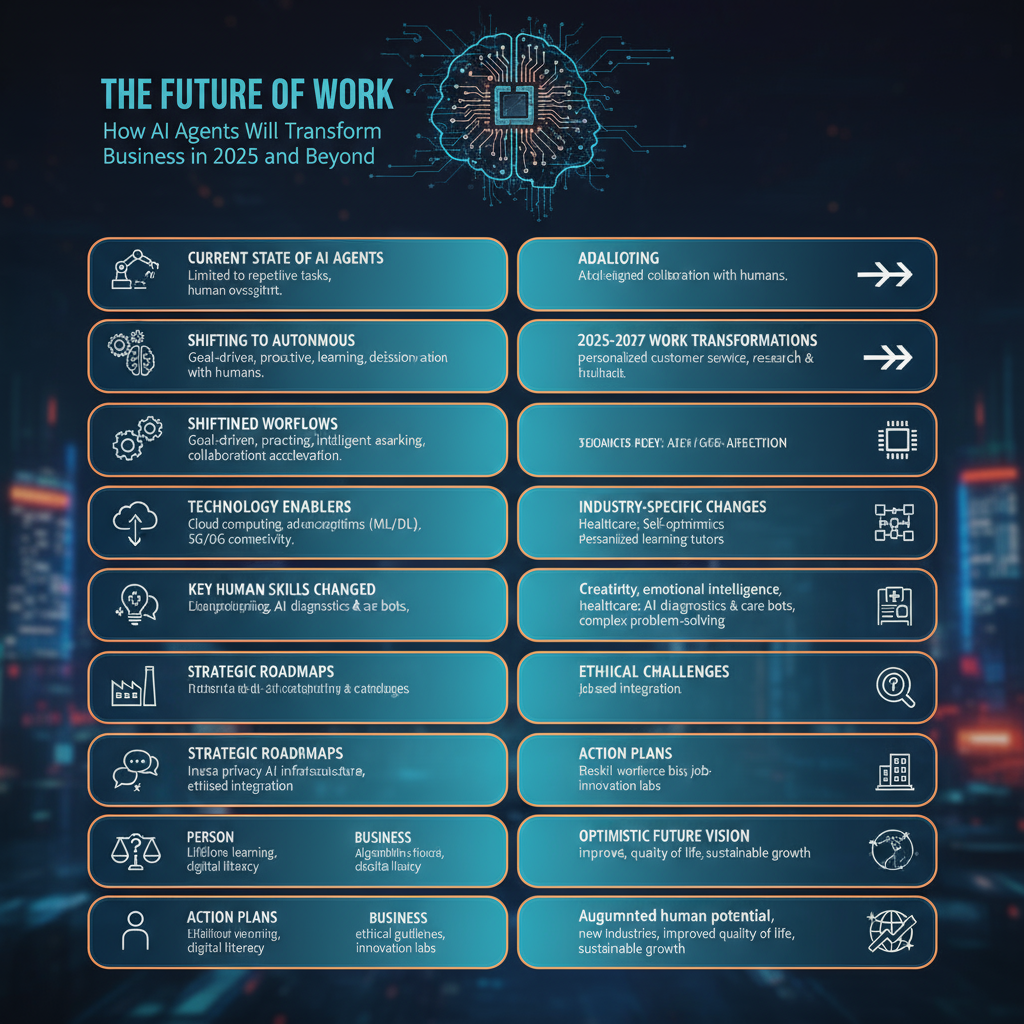
The Future of Work: How AI Agents Will Transform Business in 2025 and Beyond
We’re standing at an inflection point in how work gets done. AI agents aren’t just tools anymore—they’re becoming coworkers, and this shift is happening faster than most people realize. | future of work AI I’ve been deep in the AI automation space for three years, and the pace of change is extraordinary. Let me share what’s coming and how you can prepare. Where We Are Today Right now, AI agents handle discrete tasks: researching topics, drafting emails, analyzing data, generating content. They’re assistants—helpful but limited. Most businesses are still in the experimentation phase. They’ve tried ChatGPT, maybe built a simple automation or two. Some are using AI features in their existing tools. This is where adoption typically stalls. Companies wait for AI to get “better” before investing seriously. That’s a mistake. The Shift Happening Right Now AI agents are evolving from task-executers to autonomous workers. Here’s what’s changing: From single-task to multi-task agents: Early 2024, AI handled one task at a time. Now, agents chain multiple tasks together, making decisions about what needs to happen next. From prompted to proactive: We’re moving from “tell the AI what to do” to “tell the AI what you want to achieve.” Agents figure out the how. From isolated to collaborative: Multiple specialized agents working together, each handling what they do best, coordinating to achieve complex goals. From supervised to autonomous: Less human oversight needed for routine decisions. Agents handle exceptions and only escalate genuine edge cases. This isn’t science fiction. These capabilities exist today. The question is adoption speed. What Work Will Look Like in 2025-2027 Based on current trajectories and what’s already in development, here’s my forecast: Customer-Facing Roles Transform AI agents will handle 70-80% of customer interactions from first contact through resolution. Not just chatbots—actual problem-solving agents that can access systems, process refunds, update accounts, and handle complex scenarios. Human customer service will focus exclusively on: Companies will need fewer customer service reps, but the ones they employ will be more skilled, better paid, and handle genuinely interesting problems. Knowledge Work Becomes Agent-Assisted Every knowledge worker will have AI agents handling their repetitive cognitive tasks: Analysts won’t manually pull data and create reports. Agents will continuously monitor data sources, generate insights, flag anomalies, and produce visualizations. Analysts will focus on interpreting findings and recommending actions. Marketers won’t spend hours creating campaign variants. Agents will generate content, test messaging, optimize targeting, and report results. Marketers will focus on strategy and creative direction. Developers won’t write boilerplate code or fix simple bugs. Agents will handle routine coding, testing, and documentation. Developers will architect systems and solve novel problems. Salespeople won’t manually research prospects or follow up. Agents will gather intelligence, personalize outreach, manage pipelines, and surface opportunities. Sales teams will focus on relationship building and closing. The pattern is clear: AI handles the routine, humans handle the exceptional. New Job Categories Emerge We’ll see entirely new roles: AI Agent Managers: People who oversee teams of AI agents, similar to how managers oversee human teams. They monitor performance, handle escalations, and optimize agent workflows. Prompt Engineers (but evolved): Not just writing prompts, but designing complex agent systems, integrating tools, and ensuring agents make good decisions. AI Trainers: Specialists who fine-tune agents for specific industries or use cases, teaching them company-specific knowledge and processes. Human-AI Collaboration Specialists: People who design workflows that optimally blend human and AI capabilities. AI Ethics and Compliance Officers: Ensuring AI agents make decisions aligned with company values and legal requirements. These roles are already appearing at forward-thinking companies. The Technology Enabling This Future Several technologies are converging to make this possible: Multimodal AI: Models that understand text, images, audio, and video. This means agents can truly interact with the digital world as humans do. Long-context windows: AI can now “remember” entire conversations, documents, or project histories. This enables continuity and context-aware decision making. Tool use and function calling: AI can now reliably use APIs, databases, and software tools. They’re not just text generators—they’re operators. Agent frameworks: Platforms like LangChain, AutoGPT, and CrewAI make building complex agent systems accessible to anyone with basic coding skills. Affordable inference: Running AI models is getting cheaper rapidly. What cost $1 per interaction in 2023 might cost $0.01 in 2025. These aren’t future technologies—they exist now. We’re in the deployment phase. Industry-Specific Transformations Different industries will transform at different speeds: Tech and Software (Already Transforming) Software companies are leading adoption because they understand the technology and can move quickly. Expect AI agents to handle customer support, code review, testing, documentation, and deployment by late 2025. Professional Services (2025-2026) Legal, accounting, consulting firms will use AI agents for research, document analysis, report generation, and client communication. Junior associate work gets largely automated. Healthcare (2026-2027) Administrative AI agents will handle scheduling, billing, insurance verification, and medical records. Clinical AI will assist with diagnosis, treatment planning, and monitoring. Doctors focus on patient interaction and complex cases. Education (2025-2027) AI teaching assistants will provide personalized tutoring, grade assignments, answer questions, and track progress. Human teachers focus on mentorship, motivation, and social-emotional learning. Manufacturing and Logistics (2025-2026) AI agents will optimize supply chains, manage inventory, coordinate shipping, and handle quality control monitoring. Operations become more efficient with fewer human touchpoints. Retail and E-commerce (Already Transforming) AI agents manage customer inquiries, personalize shopping experiences, optimize pricing, and handle returns. Physical retail sees slower adoption than online. The Skills That Will Matter As AI handles more routine work, certain human skills become exponentially more valuable: Critical Thinking: The ability to question AI outputs, spot flaws in reasoning, and make judgment calls. Creativity: Generating truly novel ideas that AI hasn’t been trained on. Emotional Intelligence: Understanding and navigating human emotions, something AI struggles with. Systems Thinking: Understanding how complex systems interact and designing efficient workflows. Adaptability: Learning new tools and adjusting to rapidly changing work environments. AI Literacy: Understanding what AI can and cannot do, how to work with it effectively, and when to trust it. The good news? These are all