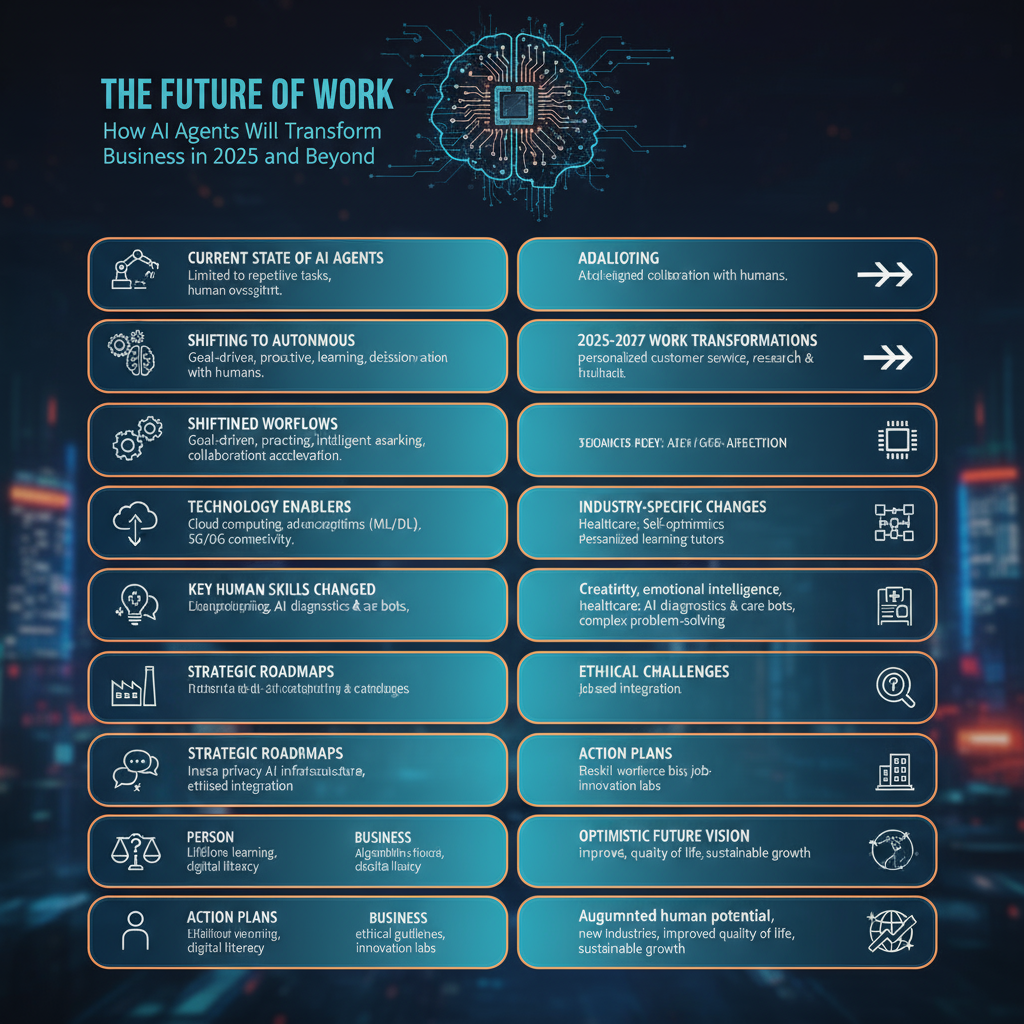

Agentic AI: How Autonomous AI Agents Are Transforming Business Operations in 2025
Introduction The business landscape is experiencing a seismic shift with the emergence of Agentic AI—autonomous artificial intelligence systems that can plan, make decisions, and take actions independently to achieve user-defined goals. Unlike traditional AI that merely responds to prompts, Agentic AI proactively identifies problems, formulates strategies, and executes solutions without constant human oversight. Industry analysts predict that by 2028, approximately 15% of organizational work decisions will be made autonomously by AI agents. This transformative technology is reshaping how businesses operate, compete, and deliver value to customers. In this comprehensive guide, we’ll explore what Agentic AI is, how it works, its real-world applications, implementation strategies, and how your organization can leverage this revolutionary technology to gain competitive advantages. What is Agentic AI? Agentic AI refers to artificial intelligence systems designed with agency—the ability to act independently, make autonomous decisions, and pursue goals with minimal human intervention. These intelligent agents can perceive their environment, process complex information, learn from experiences, and take calculated actions to accomplish specific objectives. Key Characteristics of Agentic AI: Unlike conventional AI chatbots that respond reactively to user queries, Agentic AI systems take initiative. They analyze situations, formulate action plans, execute tasks, monitor outcomes, and adjust strategies dynamically. How Agentic AI Differs from Traditional AI Aspect Traditional AI Agentic AI Interaction Reactive, responds to prompts Proactive, initiates actions Decision-making Limited to predefined rules Autonomous, context-aware choices Task Complexity Single-step responses Multi-step workflow execution Learning Static after training Continuous adaptation Goal Achievement Requires human guidance Independent goal pursuit Planning No planning capability Strategic planning and execution Core Technologies Powering Agentic AI Agentic AI combines multiple advanced technologies: 1. Large Language Models (LLMs) Foundation models like GPT-4, Claude, and Gemini provide natural language understanding, reasoning capabilities, and knowledge synthesis. 2. Reinforcement Learning Enables agents to learn optimal behaviors through trial-and-error interactions with their environment, receiving rewards for successful actions. 3. Multi-Agent Systems Coordinated networks of specialized AI agents that collaborate, share information, and divide complex tasks efficiently. 4. Tool Integration APIs Connections to databases, software applications, IoT devices, and external systems that agents can manipulate to accomplish tasks. 5. Memory Systems Short-term and long-term memory architectures that allow agents to maintain context, recall past interactions, and build knowledge over time. 6. Planning Algorithms Sophisticated techniques like Monte Carlo Tree Search and hierarchical planning that enable agents to strategize multi-step solutions. Real-World Applications of Agentic AI 1. Customer Service Automation Agentic AI customer service agents can: Business Impact: Companies report 40-60% reduction in customer service costs while improving response times and customer satisfaction scores. 2. Supply Chain Optimization AI agents autonomously: Business Impact: Organizations achieve 15-25% reduction in supply chain costs and 30-40% improvement in inventory accuracy. 3. Financial Trading and Analysis Financial AI agents: Business Impact: Faster execution speeds, reduced emotional bias, and 24/7 market monitoring capabilities. 4. Software Development Development AI agents: Business Impact: Development teams report 30-50% productivity increases and faster time-to-market. 5. Healthcare Diagnostics Medical AI agents: Business Impact: Earlier disease detection, reduced diagnostic errors, and improved patient outcomes. 6. Marketing Campaign Management Marketing AI agents: Business Impact: 20-35% improvement in campaign ROI and significant time savings for marketing teams. Benefits of Implementing Agentic AI 1. Enhanced Operational Efficiency AI agents work continuously without breaks, handling repetitive tasks faster and more accurately than humans, freeing employees for strategic work. 2. Scalability Organizations can scale operations without proportional increases in headcount. AI agents handle surges in demand seamlessly. 3. Cost Reduction Automation of routine tasks reduces labor costs while maintaining or improving quality standards. 4. Improved Decision-Making AI agents analyze vast amounts of data quickly, identifying patterns and insights humans might miss, leading to better-informed decisions. 5. 24/7 Operations Unlike human workers, AI agents operate around the clock, enabling continuous business operations and faster response times. 6. Consistency and Accuracy AI agents follow procedures precisely, reducing errors caused by human fatigue, distraction, or inconsistency. 7. Personalization at Scale AI agents can deliver individualized experiences to thousands or millions of customers simultaneously. Challenges and Considerations 1. Trust and Reliability Organizations must ensure AI agents make appropriate decisions, especially in high-stakes scenarios requiring human judgment and ethical considerations. 2. Governance and Compliance Implementing AI governance frameworks to manage legal, ethical, and operational performance is essential. Companies need clear policies on AI decision-making authority and accountability. 3. Integration Complexity Connecting AI agents to existing systems, databases, and workflows requires significant technical expertise and can be time-consuming. 4. Data Quality and Security AI agents depend on high-quality data. Poor data leads to poor decisions. Additionally, organizations must protect sensitive information from unauthorized agent access. 5. Transparency and Explainability Understanding why an AI agent made specific decisions is crucial for troubleshooting, compliance, and building user trust. 6. Change Management Employees may resist AI implementation due to job security concerns. Effective change management and training programs are essential. Implementation Strategy for Agentic AI Phase 1: Assessment and Planning Step 1: Identify Use Cases Step 2: Evaluate Readiness Step 3: Define Success Metrics Phase 2: Pilot Implementation Step 4: Start Small Step 5: Build Infrastructure Step 6: Train and Monitor Phase 3: Scaling and Optimization Step 7: Expand Gradually Step 8: Establish Governance Step 9: Continuous Improvement Best Practices for Agentic AI Success 1. Maintain Human Oversight Critical decisions should require human approval, especially in areas affecting safety, privacy, or significant financial impact. 2. Invest in Data Quality Ensure data is accurate, complete, current, and properly labeled. Garbage in equals garbage out. 3. Design for Transparency Build systems that can explain agent reasoning and decision-making processes to stakeholders. 4. Prioritize Security Implement robust authentication, authorization, and encryption to protect systems from unauthorized agent access. 5. Focus on User Experience Design agent interactions to be natural, helpful, and aligned with user expectations and preferences. 6. Establish Clear Boundaries Define explicit limits on agent authority and decision-making scope to prevent unintended consequences. 7. Create Feedback Loops Enable users to rate agent performance and provide corrections that improve future behavior. The Future of Agentic AI The trajectory