
AI Agents vs Traditional Automation: What’s the Real Difference?
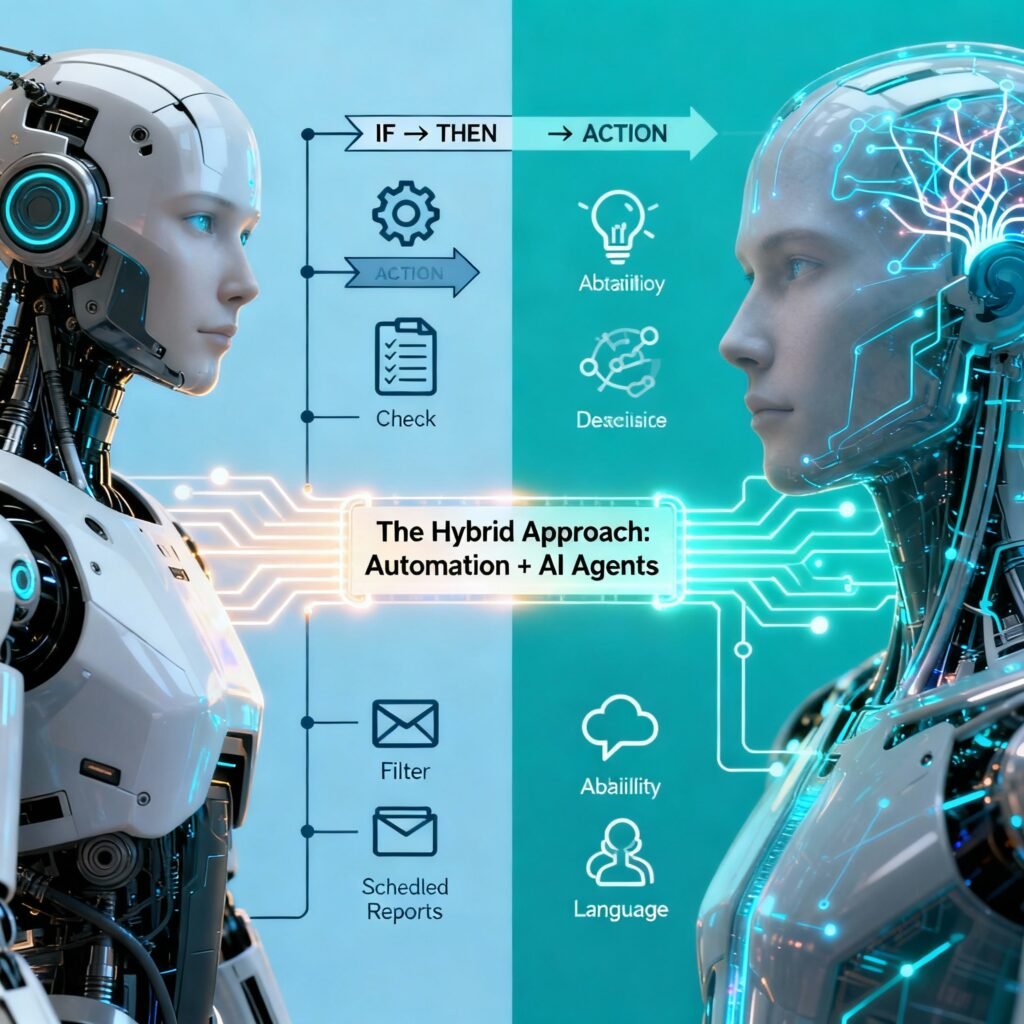
Everyone’s talking about AI agents like they’re the future of automation. But here’s what’s confusing people: how are AI agents actually different from the automation we’ve been using for years? | AI agents vs automation I get this question constantly, so let’s clear it up once and for all. Traditional Automation: The Rule Follower Traditional automation is like a highly obedient assistant who follows your instructions exactly. You tell it: “When X happens, do Y.” It does Y every single time X happens, without deviation. Think of it as a flowchart made executable. If this, then that. If condition A, do action 1. If condition B, do action 2. Predictable, reliable, deterministic. Examples you’re probably already using: These work great for repetitive, rule-based tasks with clear logic. AI Agents: The Thinking Assistant AI agents are fundamentally different. They don’t just follow rules—they reason, make decisions, and adapt to situations. Instead of saying “do Y when X happens,” you tell an AI agent: “Here’s my goal. Figure out how to achieve it.” The agent then: It’s less like following a flowchart and more like working with a junior employee who can think through problems. The Key Differences That Actually Matter Decision Making Traditional automation: Follows predefined rules only AI agents: Make contextual decisions based on understanding Example: You receive a customer email. Traditional automation sees keywords like “refund” and routes to the refunds team. An AI agent reads the entire email, understands the customer is actually asking about returning an item to get a different size (not a refund), and routes to the exchange team instead. Adaptability Traditional automation: Breaks when encountering unexpected scenarios AI agents: Adapt to novel situations using reasoning Example: A workflow step fails. Traditional automation stops and sends an error notification. An AI agent tries alternative approaches, uses different tools, or escalates intelligently while providing context on what it attempted. Natural Language Understanding Traditional automation: Requires structured inputs and exact formatting AI agents: Work with messy, human language Example: Processing meeting notes. Traditional automation needs notes formatted with specific headers and bullet points. An AI agent can read free-form notes in any format and extract action items, decisions, and follow-ups automatically. Goal-Oriented Behavior Traditional automation: Task-oriented (complete this specific action) AI agents: Goal-oriented (achieve this outcome, however necessary) Example: Research a potential client. Traditional automation might check LinkedIn and save the profile. An AI agent researches the person across multiple platforms, identifies recent activity, finds company news, notes shared connections, and compiles a comprehensive brief—whatever it takes to support your goal of understanding the prospect. When Traditional Automation Still Wins Don’t rush to replace all your automation with AI agents. Traditional automation is often the better choice when: Predictability is critical: Financial transactions, compliance processes, safety-critical systems. You want deterministic behavior, not intelligence. Speed is essential: Traditional automation executes faster. No reasoning time required. Costs matter: AI agents consume API credits. For high-volume, simple tasks, traditional automation is more economical. The logic is simple: If your automation is “copy this from here to there,” traditional tools are perfect. Don’t overcomplicate. Audit trails are required: Traditional automation has clear, traceable logic. AI agent reasoning can be harder to audit. When AI Agents Transform Everything AI agents shine in scenarios that traditional automation handles poorly: Unstructured data: Processing emails, documents, images, conversations—anything that doesn’t fit neatly into fields. Contextual decisions: When the right action depends on understanding nuance and context. Multi-step problem solving: Tasks that require planning, execution, evaluation, and adjustment. Personalization at scale: Creating unique responses or content for individuals based on their specific situation. Complex research tasks: Gathering information from multiple sources and synthesizing insights. Customer interactions: Conversations that require understanding intent, emotion, and context. The Hybrid Approach: Best of Both Worlds Here’s what smart businesses are doing: combining both approaches strategically. Use traditional automation for the predictable pipeline, and deploy AI agents for the complex decision points. Real-world example: Customer support workflow Traditional automation handles: AI agent handles: The automation moves data reliably. The agent adds intelligence where it matters. Cost Considerations Let’s talk about the elephant in the room: AI agents cost more to run. Traditional automation typically has fixed monthly costs (tool subscriptions). Once built, there’s minimal incremental cost per execution. AI agents consume API credits with every action. A single agent execution might cost $0.01-$0.50 depending on complexity. Break-even calculation: If an AI agent saves you 30 minutes of work and costs $0.10 to run, and your time is worth $50/hour, you’re getting $25 of value for $0.10 of cost. That’s a 250x ROI. The key is deploying AI agents where the value justifies the cost. Building Your Automation Strategy Here’s my recommended approach for 2025: Foundation layer: Traditional automation for high-volume, simple, predictable tasks. This is your reliability layer. Intelligence layer: AI agents for complex, contextual, high-value tasks. This is your differentiation layer. Human layer: Humans for judgment calls, relationship building, and creative work. This is your value layer. Most businesses should aim for a 70-20-10 split: 70% traditional automation, 20% AI agents, 10% human touch. Common Misconceptions “AI agents will replace all automation” No. They complement it. Traditional automation remains superior for many use cases. “AI agents are too expensive” For the right use cases, they deliver massive ROI. It’s about deployment strategy. “AI agents are too complicated to build” Frameworks like LangChain and AutoGPT have made agent development accessible to anyone with basic coding skills. “AI agents are unreliable” They’re probabilistic, not deterministic. This doesn’t mean unreliable—it means you need proper error handling and human oversight. The Future is Multi-Agent The next evolution is multiple AI agents working together, each specialized for specific tasks. One agent handles research. Another manages communication. A third coordinates actions. They collaborate to achieve complex goals that no single agent could handle. We’re already seeing this in advanced implementations, and it’ll become mainstream within 18-24 months. Making Your Decision Ask yourself these questions: Does this task require understanding context and nuance? → AI agent